Understand what drives you
You'll find your leading instinct: stability and money, people and approval, or emotions and attention. It becomes clear what to look for, what to strive for and what to avoid.

A book about the meaning of life for people who don't trust psychologists
No esoterics, no spiritual practices. Just what science knows about the brain, plus the experience of a psychologist who has spent 15 years helping people remember why they get up in the morning.
An email with a link to the book arrives right after payment.
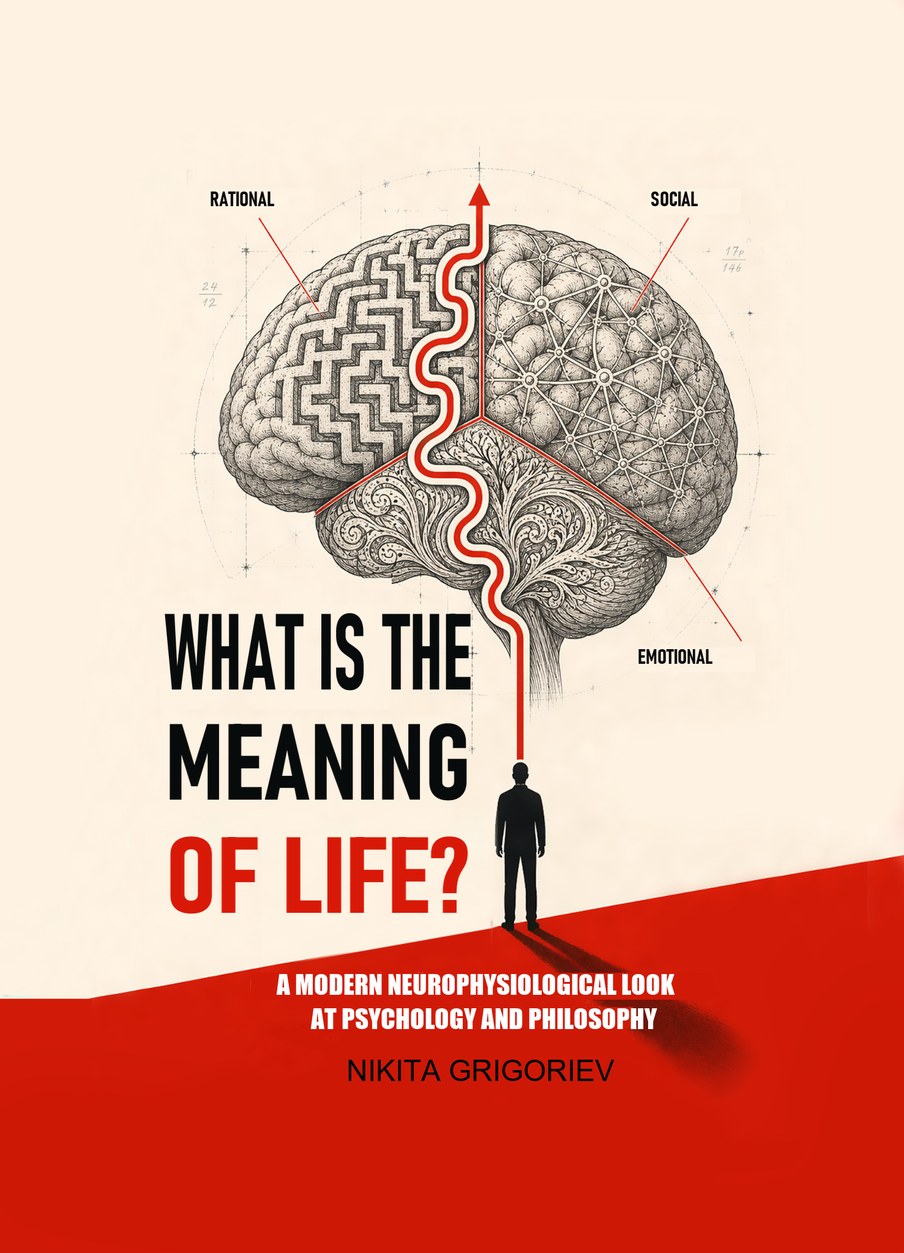
Divorce, burnout, depression, panic attacks. Every conversation still comes back to the same questions.
Almost everything we want, fear and fight about revolves around them.
No auras, no birth charts. Grounded in brain research and in what works in practice.
Not a magic pill, but a clear map: what's going on “under the hood” and what to do about it.
You'll find your leading instinct: stability and money, people and approval, or emotions and attention. It becomes clear what to look for, what to strive for and what to avoid.
What your partner, parents and coworkers do will stop looking “bad” or inexplicable. Behind it you'll see a brain trying to meet its needs.
Anxiety, laziness and outbursts aren't weakness of character but the automatic brain at work. The energy that went into self-judgment will go toward your goals.
You'll see why the feed, sweets and one-click shopping are so hard to resist, and how to get your brain its real “dopamine paycheck” back.
Instead of endlessly “finding yourself,” you'll get a picture of the future and a route to it, step by step, on paper.
You'll learn to spot “social debts,” the invisible expectations couples fight over, and to clear them without arguing about who's right.
You don't need to be a doctor to have basic knowledge of your own body. In the same way, you don't need to be a professional psychologist to understand the basic mechanisms of the mind and the brain.
It's knowledge of how the brain works and techniques that help you steer it instead of being steered by it. That's why this book is for people who are tired of gurus and ready-made recipes for happiness.
The book's main idea
The brain rewards us with dopamine when an instinct is satisfied and switches on anxiety when it's under threat. The feeling that life has meaning is born in this simple system.
The three instincts argue constantly, like three advisers in one room. The book teaches you to hear that argument and choose who gets the floor. Then meaning stops being an abstraction and becomes a route.
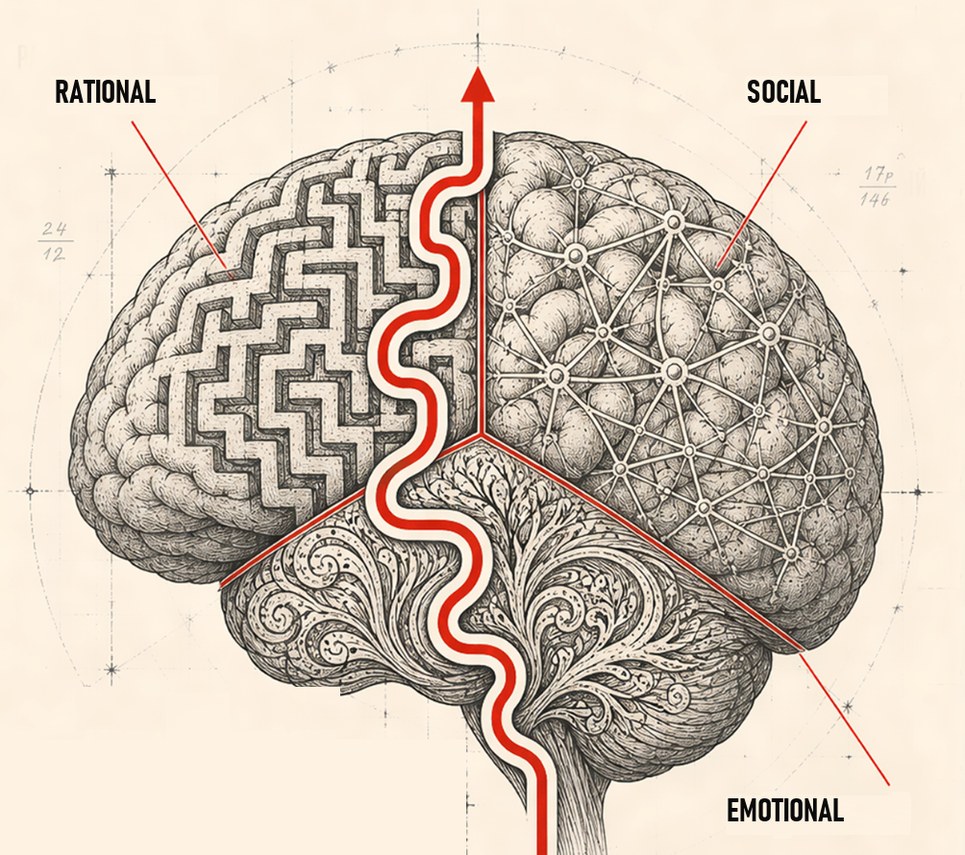
Safety, money, a plan and a predictable future.
Meaning“I know where I'm going and why I get up in the morning.” There's a goal and a route to it, and the brain rewards every step with dopamine.
Anxiety“What will happen to my job? To the economy? Where am I even going?” The future is foggy, and the brain sounds the alarm even though you're sitting safely on your couch at home.
Your place among people, recognition, the support of the “pack.”
Meaning“Here I'm understood and accepted. These are my people.” According to the Harvard study, this matters more than money or career.
Anxiety“What did they think of me? Maybe they're offended?” To the ancient brain this sounds like “they'll throw me out of the pack, and I'll die alone in the forest.”
Attention, admiration, vivid experiences.
Meaning“I live vividly, and people look at me with admiration.” Music, dance, the stage, a new encounter: the brain gets its dose of delight.
Anxiety“Life feels bland. Everyone else's is brighter and cooler, and nobody looks at me.” And your hand reaches for the feed on its own, for a quick dose of excitement.
…it feels as if a holographic indicator lights up over people's heads. This indicator explains why they talk the way they do, what they really want, how to communicate with them and what to expect from them.
The author retells it in plain language. You can open the originals and check for yourself.
A neurosurgeon touched the cortex with an electrode during operations. Patients moved a hand or felt a touch they hadn't chosen.
Brain, 1937 →More than 85 years of following the lives of hundreds of people and their children. Health and happiness in old age are most closely tied to the quality of relationships.
Harvard Study of Adult Development →Moruzzi and Magoun stimulated a cat's brainstem, and even under anesthesia its cortex switched into waking mode. In later experiments, the same stimulation woke sleeping cats for real.
Electroencephalography and Clinical Neurophysiology, 1949 →Rats pressed a lever that stimulated their reward system up to a thousand times an hour, forgetting about food and sleep.
J. of Comparative and Physiological Psychology, 1954 →Dogs that couldn't escape electric shocks later didn't even try to jump a low barrier, though the way out was right there.
J. of Experimental Psychology, 1967 →John Calhoun built a paradise for mice: unlimited food, no predators. Mouse society fell apart, and the population died out.
Proc. of the Royal Society of Medicine, 1973 →Capuchin monkeys did the same task. The one given a cucumber instead of a grape angrily refused to keep working.
Nature, 2003 →In 28 men convicted of serious crimes: the higher the psychopathy score, the more dopamine metabolite in their tests.
J. of Neurology, Neurosurgery & Psychiatry, 2003 →Stanford's Vinod Menon showed that the three main brain networks work as one system and pull attention away from each other.
Trends in Cognitive Sciences, 2011 →Max Planck Institute scientists could see on fMRI which button a person would choose before the person was aware of deciding.
PLoS ONE, 2011 →Participants listened to 60 tracks in a scanner. Music they truly liked activated the nucleus accumbens, the center of dopamine reward.
Science, 2013 →“Strong-willed” people aren't stronger than others. They arrange their lives so temptation comes up as rarely as possible.
J. of Personality and Social Psychology, 2015 →Also: George Engel's biopsychosocial model (Science, 1977), Wendy Wood's research on habits (J. of Personality and Social Psychology, 2002), Thomas Yeo's map of cortical networks (J. of Neurophysiology, 2011)
…and many more
We aren't made for happiness. We're biological creatures made for survival in the wild, in packs.
Twelve parts: from how the brain works to specific writing techniques.
Why “just live” doesn't help, and how psychology differs from rituals.
The brain as an automatic organ: why you can't order yourself to love the gym.
Rational, social and emotional: a map of everything we want.
Which instinct leads in you and how it becomes your compass.
Genes, mind and environment. Why self-judgment only gets in the way of change.
How the instincts argue with each other, and where you are in that argument.
Why there's so much anxiety in the most comfortable world in history.
What the brain does when it can't get its reward the honest way.
How “one-click” living weakens the brain the way zero gravity weakens muscles.
Three writing techniques: from a stream of thoughts to the next step.
Why anxiety comes back even when the problem is already solved.
All the pieces of the mosaic in one picture.
If you feed the brain “pre-chewed food” every day, it gradually forgets how to chew.
The practical part
Techniques from the “Practical Solutions” chapter, with detailed examples. You'll need a notebook, a pen and 10–20 minutes. Everything is done on paper: writing slows the brain down and keeps it from jumping between scraps of thoughts.
Dump the anxious “playlist” out of your head and onto paper.
Draw the “city on the horizon” and work your way back to it, step by step.
Manual control of the brain when it reaches for cheap dopamine.
Helplessness isn't weakness. It's the lack of a ready-made template for behavior.

About the author
A practicing psychologist in Tallinn with more than 15 years of experience. People come to him after divorce and loss, with burnout, depression and panic attacks.
Whatever the problem, the conversation sooner or later came back to the same questions. Nikita noticed he was explaining the same things to almost every client and decided to set them out clearly and simply in one book.
Reviews of Nikita's consultations from his Google profile, most of them translated from Russian. Readers' reviews of the book will appear here.
4,6★63 reviews on Google →Nikita is a specialist who very gently and precisely helps you see what had stayed unclear for a long time. …
A psychologist who really helps by explaining how the brain works. His professional, respectful and calm approach gives you a sense of acceptance and safety, which makes the consultation even more effective. I now recommend him to everyone. 100/10 🔥
A unique specialist, energy 100+ and a very positive attitude. No tension at all during therapy. He opened my eyes to simple things I probably wouldn't have figured out on my own. It's very easy with him; everything really is very simple.
I had an amazing conversation with Nikita that helped me pinpoint many problem spots in how I perceive reality. Highly recommend
I want to say that this was the first time I felt so comfortable talking to a psychologist. …
A psychologist who really helps. Clear, to the point, no fluff. I've been to many psychologists, but for me Nikita is now the best of the best! 😊🥳🤗👍👏
Nikita isn't just a professional but a person who sincerely wants to help. I came in anxious and left with clarity, lightness and even a smile. The atmosphere is comfortable, everything clear and understandable. If you're wondering who to turn to, definitely Nikita!
Huge thanks for the help!!! Nikita explains things simply and clearly, and he's very easy to open up to: it feels comfortable and calm with him.
Nikita is a skilled and professional psychologist. I highly recommend his service as you will get detail information from scientific point view and can openly discuss and make a plan how to find a way for solving different challenges.
Working with Nikita exceeded my expectations. The session was full of deep understanding and empathy. …
I've been to many psychologists and coaches, but there was never a result. Just a lot of questions left over. …
Definitely 10/10. Each of us has our own problems, but from my experience I'll say I really liked how Nikita explains what this or that is made of …
We went to Nikita for family therapy. No unnecessary information, everything competent and to the point, in a relaxed atmosphere …
As I see it, a psychologist is a combination of education, upbringing, common sense, appearance, approach and experience. …
Working with Nikita wasn't what I expected; it exceeded all my expectations. As soon as I walked in, I understood what a warm and pleasant person he is. He really helped me figure myself out. The best psychologist I've ever seen)
Nikita has a way of putting you at ease right from the start. He provides a perspective that helps clarify complex issues, making them feel more manageable …
One of the most intelligent, listening, comforting and safe people I know, psychologist whom you can trust with anything that’s in your head or heart. A professional who purely cares about your wellbeing and recovery.
An excellent specialist who gives concrete answers and practical recommendations. Recommend!
Thank you.
Nikita is a very competent specialist. He listens carefully and gives well-grounded, constructive recommendations …
I want to thank psychologist Nikita for the highly professional psychological help he gave our child. Kind regards, Lidia
If I could give 10, I'd give 10. Goal “find my psychologist”: achieved. Highly recommend.
A very good psychologist, I recommend him to anyone with problems, he helped us a lot
A good psychologist, glad I found him and booked a consultation
Nikita is a true professional! I gave myself the BEST New Year's gift by seeing Nikita on 30.12.2021. …
I've been to one session. I thought about it for a long time and doubted whether to go and spend €100 on a first session. In the end I decided to go. After the session I realized it was worth every cent and that I'd come to someone who knows exactly what he's doing. I booked again.
I saw psychologist Nikita Grigoriev today. EXCELLENT!!! Everything clear, precise and understandable. Very happy with the result of the visit.
Thank you so much!!! I wholeheartedly recommend him to anyone lost in the forest of their own life. After just one consultation I got a compass, and now I know where to go.
The very best psychologist, I'd even say awesome. After the first session I started glowing with happiness, I found a reason to live, to strive and move on, and the last …
Complex things in plain language. A couple of sessions helped me get through a postpartum crisis.
After the very first session I left feeling like I'd been "fixed" 🙂 Very professional! Thank you!
Thank you very much, Nikita. For your professional consultation …
Nikita is a very good specialist. He doesn't ask unnecessary questions. He listens carefully and really hears you. He speaks to the point, sometimes with a bit of humor. He helped me solve a difficult problem easily and naturally.
Very grateful for the session, and I recommend him to everyone!!! A wonderful attitude and a superb specialist!!!
Thank you, I understood and accepted a lot for myself 🙂 recommend!
An honest man who doesn't sell hope
I recommend him 100%. I always thought psychologists were useless, but I happened to attend one of Nikita's group sessions. …
Above all, Nikita is a wonderful person to talk to: he listens and really hears you. You want to tell him things. …
As I started writing this review, I wondered what my life would be like if I hadn't turned to psychologist Nikita Grigoriev in time. Just imagine, I saw …
Nikita helped me find the root of the problem and gave good, practical advice on how to change my life for the better. …
I recommend Nikita as an experienced specialist who knows his work! He helped me exactly when I needed it! Huge thanks!!!
It was very pleasant and easy to talk. In one hour I got more answers than in several years.
Thank you for the quick help and the clear plan of action in an emergency. Thanks to your guidance, the situation didn't escalate and was resolved without tragic consequences.
If you need an objective, neutral outside view of your situation, book a consultation with Nikita.
A good psychologist. I got a lot of information and techniques for solving my problem. It helped me; I recommend him as a psychologist!
An interesting approach. He explains things clearly and accessibly. Recommend.
He really helped me understand myself. Huge thanks!
The session flew by. He puts you at ease right away, you feel cozy and comfortable, he explains clearly what's what, and he finds the answers together with you.
Read the book? Tell us what it gave you.
You're not fighting each other. You're fighting your own brains, which hang expectations on your partner.
E-book
Card payment via Stripe. After payment you'll get an email with links to the PDF and EPUB.
Within 14 days of purchase you can ask for a full refund: info@psy-help.ee. Before paying, please read the terms of purchase and the privacy policy.
Seller: Grin studio OÜ · registry code 12261817 · Sojakooli 14-36, Tallinn, Estonia. Questions: info@psy-help.ee · +372 553 8455.
No. The book is written for readers with no special background. The author explains everything through everyday situations and examples.
After payment, an email with links to the PDF and EPUB is sent to the address you gave at checkout. If it doesn't arrive, check your spam folder or write to info@psy-help.ee.
The book helps you make sense of things and try the tools on your own. If your situation needs individual attention, reading doesn't replace working with a professional.
Yes, within 14 days of purchase. Write to info@psy-help.ee.
End of the free excerpt
Next: the chapter “You Have a Chemical Addiction”
Why every one of us has an addiction, the author included, to what exactly, and how three basic instincts run our lives.
PDF (266 pages) and EPUB. The links are sent to the email you give at checkout. Terms of purchase
Hello. My name is Nikita Grigoriev, and I've been working as a psychologist for more than 15 years. In that time, my office has seen people going through divorce and suicide attempts, identity crises, burnout, depression and panic attacks.
But whatever problem my clients and I work on, sooner or later we arrive at the same basic questions:
What makes us feel confident or weak?
What factors shape that?
What can we do to change the way we react?
And, of course, what is it all for? What's the point?
I noticed that in almost every situation I end up explaining the same things. So I decided to lay them out as clearly and simply as I can, so that anyone who feels lost on their path through life gets something solid to stand on. So that you finally feel your hands on the controls of your mind, your thoughts, your actions and, in the end, your life.
It's an important question. And a very strange one.
Important, because without an answer it's hard to find your footing. We live, we try, we go to work, we build relationships, and yet sometimes a feeling of emptiness washes over us. A sense that none of it means anything. And then despair sets in.
That's exactly when people start asking this question. And then they give up before taking the first step. After all, the greatest philosophers have been searching for the answer for thousands of years and haven't found it. What chance do the rest of us have? All that's left is to keep living and hope that, for some mysterious reason, the bad streak will eventually end.
On the other hand, the question seems strange because it appears to have an obvious answer: “The meaning of life is to live.”
But that answer sounds like a way of dodging the problem. It's like a child coming to their parents because kids at school are teasing them, and the parents saying, “Just ignore them.” It sounds reasonable, but it doesn't help at all.
In the same way, the phrase “the meaning of life is to live” does nothing for the emptiness and hopelessness inside. If it worked, you wouldn't have opened this book.
Sooner or later, the question of life's meaning comes up for every one of us. In my work with clients, we often find our way to it gradually. And every time, I see the same mix of a smile, disbelief and surprise on their faces, as if to say: What kind of question is that, Doc? It's all perfectly clear. Except nothing is.
I understand perfectly well that anyone who claims to have the answer to “What is the meaning of life?” looks suspicious. As if they're about to sell you yet another magic pill, a mindfulness course, some energy leveling-up and a jade egg or two.
I'm skeptical of all that myself. Even though I work as a psychologist, what's happening in the field right now worries me. Online gurus tell you to believe in yourself, let go of the past, heal your trauma.
Sounds great. But if we really could just let go of the past, why would anyone need a professional? We would have done it on our own long ago.
A woman once came to see me. The first thing she said as she walked in was: “No fish, please.”
I looked at her, puzzled. What fish? You came to see a psychologist, not a pet store.
She explained that her previous experience had been rather unusual. She had been asked to imagine that all her problems were bubbles and she was a little fish swimming around and popping them. “I sat there feeling incredibly stupid, just watching the clock and dreaming about getting the hell out of there,” she recalled.
And really, how would you feel if you were struggling with your business or your family? You've been carrying it for months, maybe years. And now someone tells you these are bubbles and we're going to pop them. And on top of that, you have to pay 100 euros for it. Not many people would like that.
I believe approaches like this undermine trust in psychology as a science and as a practical tool that can really help. When techniques turn into rituals of hunting for aggression in your body and years of trying to forgive your grandmother, it drives away the very people who need real help.
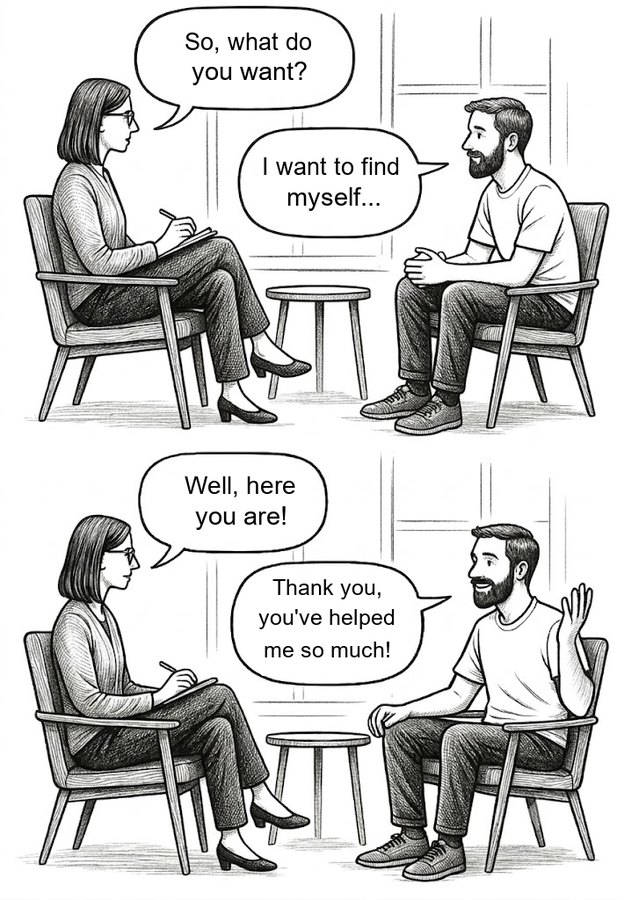
Psychology is real knowledge about how our brain works, and techniques that help you take charge of it instead of being led around by it. Magic rituals and endless talk about your childhood have nothing to do with it.
I'm not saying visualization techniques are completely useless. They can help you calm down in the moment. But they don't answer the big questions: What am I doing in this world, and what should I do with myself and with my life?
Because of stories like these, I sometimes feel awkward even telling people I'm a psychologist. The profession has been discredited by a one-sided and sometimes mystical approach. There are psychologists who will cleanse your aura, read your birth chart and pull a tarot spread for you, all in one session. None of it has any scientific basis.
Professional psychology is built on science, not on magic.
The meaning of life is an extremely important question. And that very importance is often exploited by people who sell hope and beautiful promises. As a result, anyone trying to figure things out ends up buried under an avalanche of information.
In the best case, they get disappointed and settle for the answer: “The meaning of life is just to live.”
In the worst case, they grasp at the straw held out by yet another “enlightened guru” and become a cash cow, grazing on the pretty but tasteless grass of illusory happiness.
This isn't necessarily a conspiracy or a deliberate scam. Many of these “gurus” believe in what they do. And why not, if it gets results and makes a person feel emotionally stable, at least for a while?
Me? I'm on the side of science.
If we break a leg, we don't go to church or to a fortune-teller. We go to the hospital. Why? In a sense, a hospital is a temple too. A temple of science, of biology.
And that is the difference.
What doctors do is the result of the exhausting work of many generations. The result of doubt, experiments, failed theories and even deaths. But that's exactly what gives us real results in a crisis.
At this point you'll often hear the argument: “Mysticism doesn't work for you simply because you don't believe.”
Fine, let's say that's true. Then how do I know whether I believe enough? How are we going to measure faith? How many mustard seeds does your faith have to weigh before your husband stops drinking or your grandmother's cancer goes away?
Here's a puzzle for you. When you flip a switch, does the light come on because you believe it will? No. It comes on because that's how our world works. Science managed to describe and harness these processes. We built power plants and transformers, ran the wires and connected switches to them. There's nothing mystical about it. It's a system that makes our lives better.
Science and electricity don't care whether you believe in them, or whether your prophet is Edison or Tesla. Science works because it has passed the test of doubt and experiment.
At its core, the scientific method is a statement: “Let's test it.” Real scientists eagerly look for evidence that their theories are wrong. Because if an experiment fails, it means there's still something we don't understand. We've stumbled on something new, puzzling, unexplored. And that pushes us to keep cracking reality's hidden code with new hypotheses and experiments.
If an experiment's result can be repeated regardless of faith, religion or political views, then it works. And it doesn't matter how we feel about it.
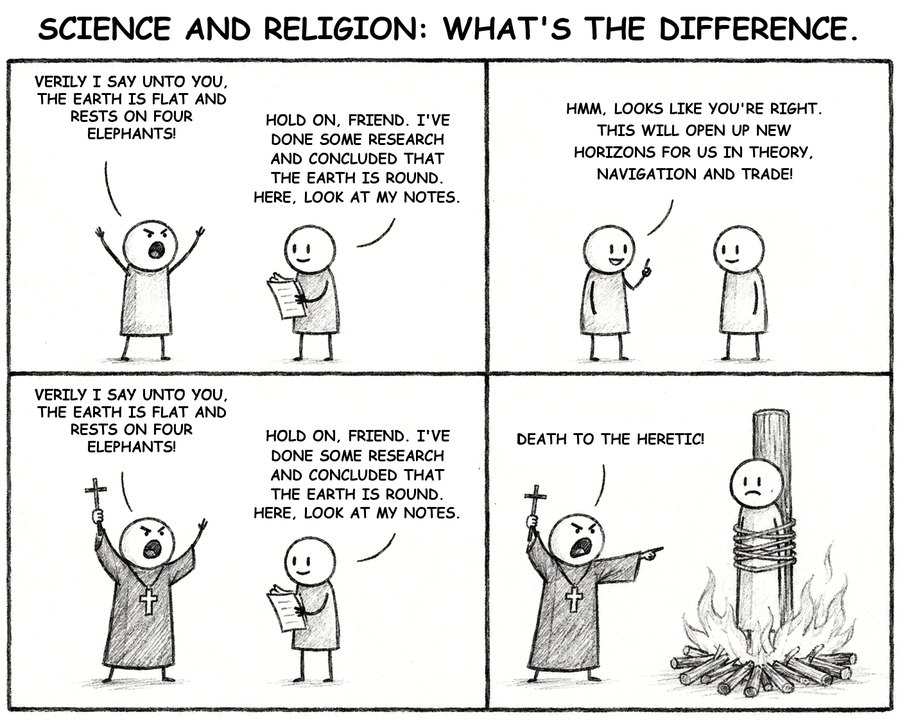
Try talking openly about your doubts with the “happiness salesmen.” You'll hear all sorts of things about yourself.
Honestly, I'd be glad if esoteric practices or religion solved problems. I wouldn't have to spend my day off sitting at the computer writing this book. I'd just pray for my bills to be paid. I'd live on prana and good vibes. And I'd spend all my free time with my wife and child.
Maybe I just don't believe enough?
I think the reason is something else. If religion or esoteric practices solved problems, I'd be out of a job as a psychologist. It's even a little sad, but that's reality: we don't need to believe, we need to understand how the world works and act on that knowledge.
This book will explain what's going on “under your hood”:
What makes you and the people around you feel grief and happiness.
Why there is so much aggression around us.
How we can speak the same language and completely fail to understand each other.
Why, with every comfort of the modern world, we still manage to be unhappy.
Why, in an age of instant communication and social media, we feel lonelier than ever.
And most importantly, we'll talk about what can be done about it.
You don't have to be a doctor to have basic knowledge about your own body. If you have a high fever, you know to take something to bring it down. If you cut yourself, you clean the wound and put a Band-Aid on it.
In the same way, you don't have to be a professional psychologist to understand the basic mechanisms of the mind and the brain.
We won't rely on theories built on observing patients, or on guesses that famous psychologists formed through their own personal lens. We'll rely on the scientific method, verifiable data and research, because neuroscience is finally shedding light on psychological processes.
For the first time in human history, we have technology that lets us look inside a living brain. And now we can understand how our mind works at the biological level: how thoughts, emotional reactions and even decisions are formed, the very decisions that ultimately shape our whole lives.
And we'll start with the basics: the brain.
Many people are convinced that we are rational beings. But that isn't true. Not even close.
A strange claim, right? After all, we can sit down, stand up, jump or not jump whenever we please. And in the end, it's us, not somebody else, who makes the decisions about our own lives!
I get it. It was hard for me, too, to accept the fact that we're not really our own masters. So let me explain.
Yes, we control our muscles and our speech, up to a point. But try falling asleep on command. Or lowering your body temperature during a cold without medication.
And what about everyday things like overeating, not moving enough or smoking? Who is doing all that to us?
Is it really our conscious wish to spend hours, weeks and months of our lives trying and failing to reach the end of our Instagram feed?
I know perfectly well that I should go to the gym, because it's good for my health. But the moment it's time to get up off the soft couch, pack my bag, walk to the car in the rain and drive to the gym, I suddenly don't want to anymore!
So do I want to or not? And who inside me is making the decision?
The thing is, our brain is an automatic organ. And we can't control automatic organs.
Every morning I ask my fat cells to store a little less fat. I literally scold them! “Guys, enough! How much more do you need? We're fully stocked down there!” But for some reason they don't listen to me.
Or take a person with diabetes and tell him: “Joe, make more insulin, it's important!” Will Joe manage it? No. Because the pancreas, which is responsible for producing insulin, works automatically.
We can't order it to switch on. In the same way, we can't order the brain to “stop craving sweets” or “start loving the gym.”
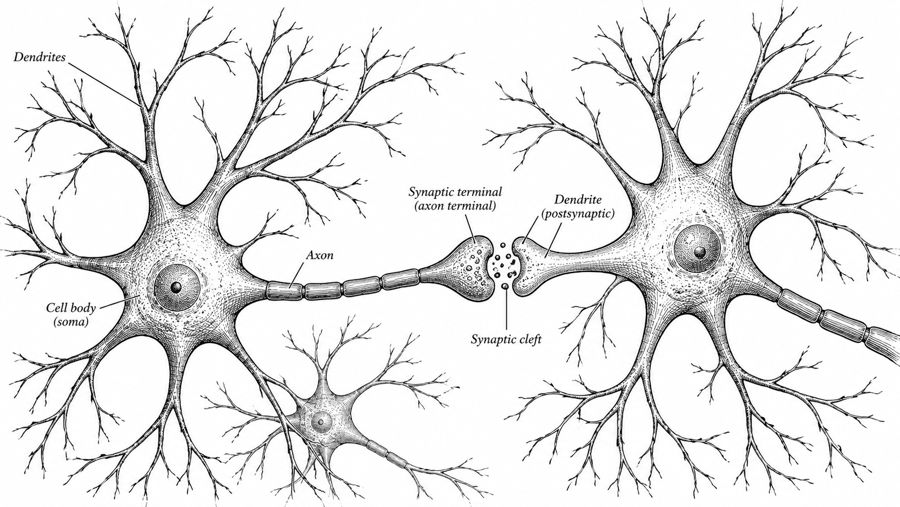
Because the brain is also made of automatic cells. About 87 billion neurons, whose job is simply to react to what is happening around us.
But how is this different from blind faith in astral energy? How can we test it?
In recent years, we have come to understand the structure and workings of this complex system better and better. And more and more often, scientists are asking: what does a “conscious action” even mean?
One of the first people who dared to look deeper into this question was Wilder Penfield, a true pioneer in understanding the brain.
From the 1930s to the 1950s, Dr. Penfield worked at the Montreal Neurological Institute in Canada. He operated on the brain to relieve epileptic seizures.
It's worth mentioning that, then as now, some brain operations are performed with the patient awake. Only the scalp is numbed. It sounds creepy, but it turns out our brain has no pain receptors. The patient stays conscious during the operation and can tell the doctors what they are feeling.
It would be a crime not to take advantage of that opportunity and give this remarkable organ “a little poke with a stick.”
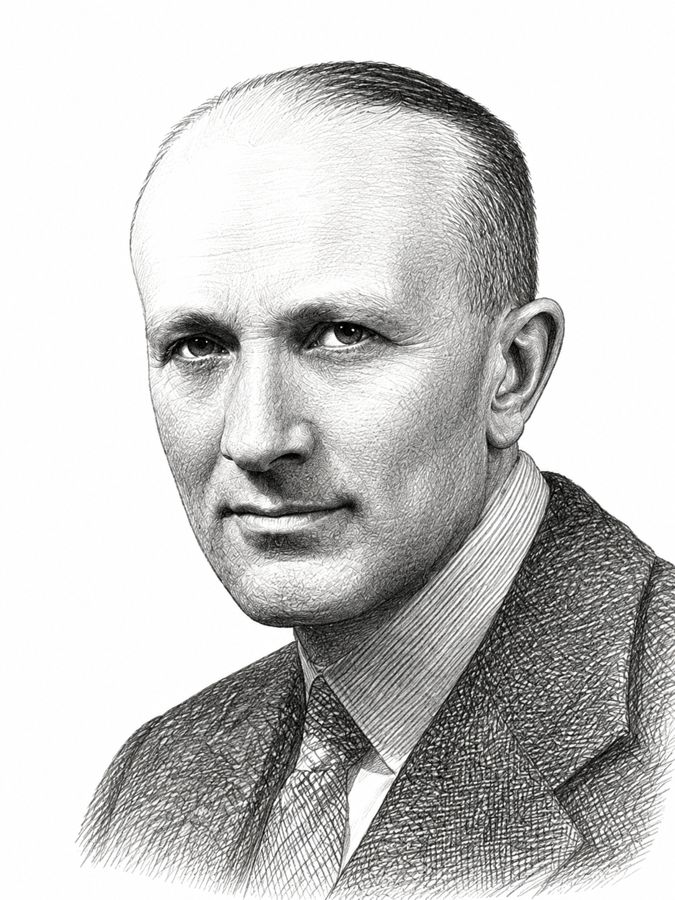
So, during these operations, Dr. Penfield touched different areas of the brain. Not with a stick, of course, but with a special electrode. That way he stimulated different regions.
And here's the interesting part: when he stimulated certain areas, people experienced strange sensations, movements or even memories. Patients reported very specific feelings: tingling in their fingers, a strange taste on the tongue, warmth spreading down one side of the body. In some cases a person's eyelids fluttered or legs twitched, and some even let out a snort.
Do you see? It wasn't the person deciding what to do next, whether to stand up or raise a hand. It was the stimulation of a specific area of the brain! The person simply found themselves moving or feeling something they hadn't chosen. A good example is an eye twitch or the sneeze reflex. The brain does it for us, and we are powerless observers.
Wilder Penfield showed that movements, sensations and even memories can be triggered from outside, bypassing a person's will. It was a first hint that our control is not as absolute as we think.
To help this sink in, let's try a thought experiment.
Imagine we have brought a hunter from an isolated tribe deep in the Amazon rainforest, a man who has spent his whole life running through the jungle with a spear. And now we show him one of the greatest achievements of modern civilization: the personal computer.
On the desk in front of him are a monitor, a keyboard and a mouse. We start pressing keys marked with letters and numbers, and the symbols immediately appear on the screen. Our guest decides that this must be the mysterious computer. (To be fair, some users still think so.)
But the keyboard isn't connected directly to the monitor. And the image isn't generated by the screen itself. Everything we see is created in a “black box”: the tower that sits under the desk, quietly humming.
The signal from the keyboard first runs down the wires under the desk and gets processed by the CPU, the memory and the rest of the electronics inside that box. Only then, a few milliseconds later, does the letter appear on the screen.
As a rule, we don't even think about what goes on inside the transistors and chips. This “black box” speaks its own language, the language of zeros and ones.
And if the computer suddenly starts acting up and we don't know the tower exists, we'll look for the problem in the monitor or the keyboard. But tapping on the screen won't bring the internet back, will it?
To fix the problem, we'll have to crawl under the desk, open the box, replace the hard drive or the thermal paste on the processor, and check that the cables are plugged in properly. Because these systems, hidden from view, are what shape what we see on the screen.
Our brain is that “black box.”
It was shaped by 250 million years of mammalian evolution, and it runs on the laws of evolution.
The thoughts we hear in our heads are only the output of its calculations, which we become aware of a moment after the brain has produced them.
Our consciousness is the monitor that displays the picture. But the picture isn't created on the screen. It is created in the box under the desk.
Now for another experiment, a more recent one, but just as strange.
It was carried out in 2011 at the Max Planck Institute for Human Cognitive and Brain Sciences in Leipzig by a group of scientists that included Stefan Bode and Anna Hanxi He.
Many people have heard of MRI; it shows up all the time in movies and medical dramas. It's a large cylindrical machine that a person is placed inside so it can scan their body or head.
There is a special kind of this machine: fMRI, functional magnetic resonance imaging.
It doesn't just see through you, it literally lights up the active areas in real time. Penfield had to open the skull and touch the brain with an electrode. Now we can put a person in a scanner, give them a task and watch on the screen what's happening under their “hood,” without any surgery at all.
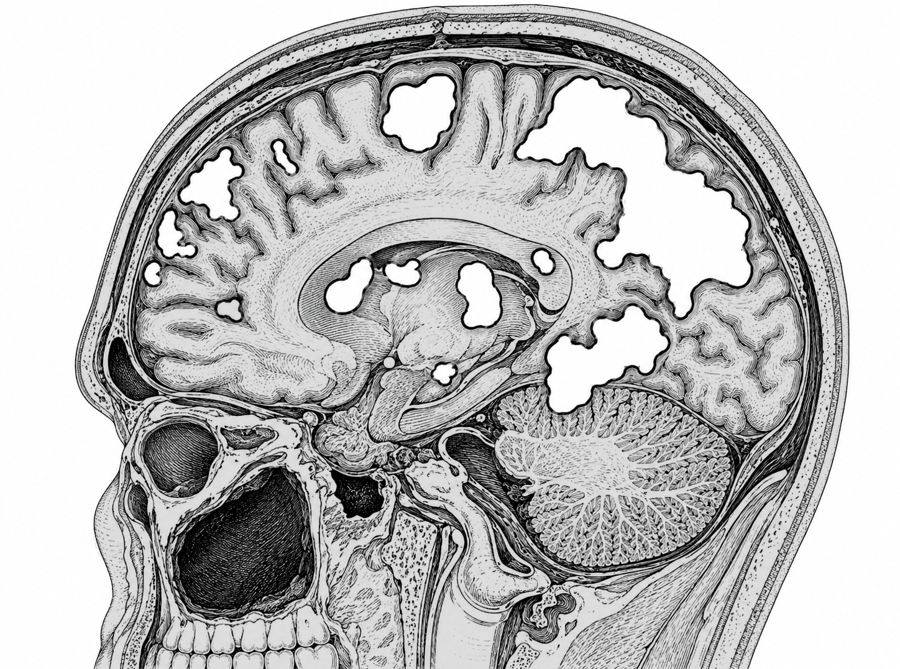
Most of what we have learned over the past few decades became possible thanks to this technology. We no longer need to open a patient's skull and stimulate the exposed brain with an electrode. It is enough to place a person in the scanner, and the inner workings of the nervous system are laid out in plain sight.
Here is one of those experiments.
Participants were placed in the scanner and asked to move first their left hand, then their right. As soon as they moved, the scientists saw the corresponding areas light up on the screen.
Then each participant was given a button for each hand and asked to think about which hand they wanted to press with. And as soon as they heard the final decision in their head, they were to press it right away.
And while the person lay there thinking about which button to press, left or right, the brain activity recorded by the scanner was already starting to point to one of the hands.
In other words, the choice was taking shape completely automatically, without the person knowing.
Based on that activity, the scientists could predict the choice better than chance, in some cases up to 7 seconds before the participant “heard” their own decision. The decision was already “ripening” in the neurons before the person was aware of it.
This is just one of many similar experiments that show the same thing again and again.
Our brain is an automatic organ made of 87 billion neurons that make decisions without our knowledge. A conscious thought is the end result of these processes, which we “see” on the monitor of our consciousness a few seconds later.
It is through this lens that we will try to understand what this automatic organ needs in order to display the following picture on the monitor of our consciousness: “My life has meaning. And I don't just know it, I feel it.”
Honestly? I have only two guarantees for you. But both are one hundred percent.
It sounds harsh, but it's true for every one of us. And it's the best reminder that the time for finding meaning isn't endless.
And every attempt gives you a chance. If it doesn't work the first time, you try again, and the odds go up.
So I suggest you start changing something. For example, with this book.
While you're still here.