
Recurring family conflicts: why the same arguments keep happening
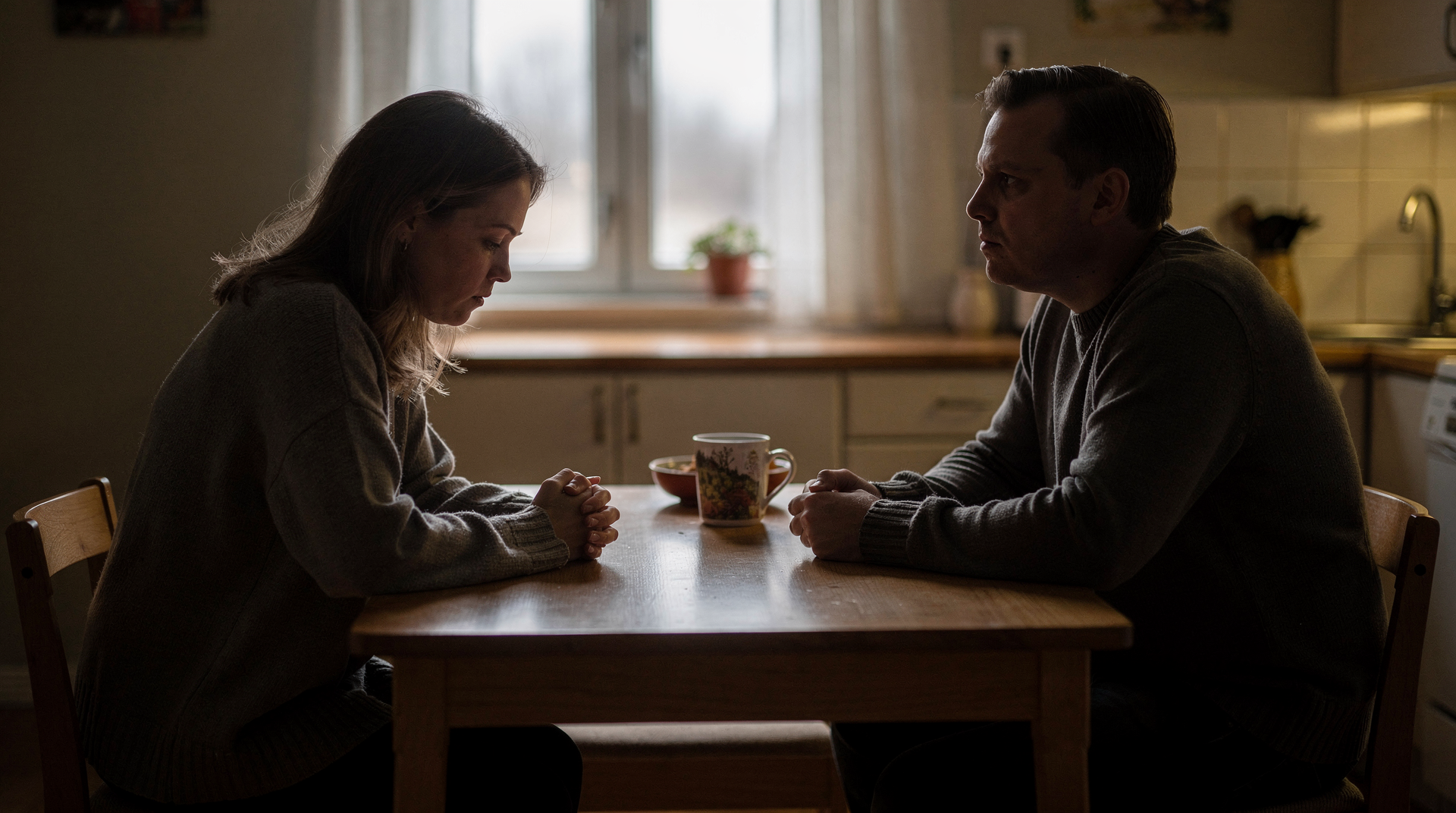
Today you argue about money, tomorrow about the children, and the next day about a cup left in the sink. The subjects change, but after the first exchange you both more or less know how it will end. One person says or does something; the other hears, “I don’t matter” or “I’m not loved,” and reacts more sharply. Their partner takes that reaction personally and starts defending themselves too. This is how an ordinary moment turns into a familiar loop — and with every new argument, the relationship feels a little less safe for both people.
Why the same conflicts keep repeating
Something happens
One person says or does something: they are late, forget a request, reply curtly, or fail to show attention. The incident may matter, but it is not yet the whole argument.
It hurts
A quick thought appears: “I don’t matter,” “I’m not loved,” or “I’m unimportant again.” You may not have put it into words before the hurt, irritation, or urge to shut down has already arrived.
Your partner responds to your reaction
They notice your tone, coldness, pressure, or silence and take that personally too. Now they feel attacked, controlled, or rejected.
The relationship feels less safe
Both people begin expecting the next blow. Each new argument seems to confirm that it is not safe to ask calmly, make a mistake, or show that something hurts.
How one incident becomes a shared conflict
Imagine an ordinary evening. One partner promised to call but did not. For the other person, this is more than a missed call. A thought quickly appears: “They forgot about me” or “They don’t care.” They meet their partner coldly and say, “Of course. I can never rely on you.”
The other person no longer hears a request for attention. They hear an accusation that they are unreliable. They explain themselves, become irritated, or answer, “Nothing is ever enough for you.” The first partner now receives fresh proof of the original hurt: “Even my feelings don’t matter.” The tension rises, although one person initially wanted to feel remembered and the other wanted not to be cast as the bad one.
By this point, nobody is talking about the missed call. One person is trying to prove that they cannot be ignored. The other is trying to prove that they should not have to defend themselves all the time. Each protects a sore point and, with every response, hits the other person’s.
Every couple has its own version of this loop. One person pushes harder for contact while the other creates distance. One demands an immediate answer while the other starts arguing the facts. Sometimes both attack. The labels matter less than the sequence: what happened → what each person heard → how each defended themselves → what came back in response.
This does not mean that both people are always equally responsible. A broken promise is still a broken promise, an insult is still an insult, and controlling behaviour is still controlling behaviour. The map is not meant to make every action equal. It shows where a specific issue stops being discussed and turns into a struggle for safety in the relationship.
What happened — and what each person heard
Try separating an argument into two layers. The first is what happened: your partner was late, broke an agreement, interrupted you, or spent money without discussing it. The second is what you heard in it: “I don’t matter,” “They don’t trust me,” “I’m being controlled,” or “I’m going to be rejected again.”
Both layers matter. If you talk only about feelings, you can lose sight of the real problem. If you argue only about facts, you may miss why a small incident became painful so quickly. “We agreed that you would message if you were late. There was no message; I became worried and felt unimportant” gives your partner more information than “You never care about me.”
Sometimes a new incident brings up accumulated mutual grievances. Sometimes the subject is abandoned and becomes an unresolved conflict. The task is not to dismiss every trigger as trivial. It is to avoid folding one fact, the entire history of the relationship, and a judgement about your partner’s character into a single accusation.
How to interrupt an automatic reaction
Once the familiar sequence has started, trying to argue “better” is often too late. A pause gives you time to notice something simple: I am responding not only to my partner’s words, but also to the meaning I heard in them.
A pause helps when it includes an explanation and a promise to return. For example: “I’m hearing that I have ruined everything again, and I’m starting to defend myself. I need to stop for now. Can we come back to this tonight?” This is not a magic phrase, and nobody has to speak perfectly. What matters is not disappearing without explanation — and actually returning at the agreed time.
After the pause, you can begin with a check rather than proof that you are right: “When you said that, I heard that you didn’t care. Is that what you meant?” Sometimes your interpretation will be accurate; sometimes it will not. Either way, the couple has a chance to discuss the real meaning rather than defend themselves against an assumed one.
What you can change on your side
One person cannot create closeness and safety for two. But you can make your own part of the loop more visible: notice sooner when a request turns into an accusation; name the painful meaning directly; avoid pursuing your partner after they ask for a pause; and avoid using silence as punishment.
The question “How do I make my partner react properly?” usually leads nowhere. A more useful question is: “What do I normally do when I feel unloved or unimportant?” Some people raise their voice, some bring out a list of old mistakes, and some close the door. This is where a small but real choice becomes possible.
Changing your response may affect the conversation, but it cannot guarantee a change in your partner. If the relationship includes persistent humiliation, threats, physical or sexual violence, coercion, or control of money and social contact, the problem is no longer simply poor communication. The first step is to consider how to protect yourself and seek specialist support.
How to make sense of the next argument
- Begin with what happened. Not “They don’t care,” but “They did not answer two messages.”
- Catch the first painful thought. Was it “I don’t matter,” “I’m not respected,” or “I’m about to be left”?
- Notice how you protected yourself. Did you push, go silent, accuse, defend yourself, or bring up the past?
- Ask what your partner saw. Do not decide for them. Find out how they understood your tone or action.
- Return to the beginning. What did you need in that situation, and what would you like to agree now?
When to see a family psychologist
Counselling may help if you already recognise the loop but cannot interrupt it together; if every conversation quickly becomes an accusation, shouting, or prolonged silence; if your children have started to fear your arguments; or if waiting for the next conflict is gradually displacing closeness.
A family psychologist does not look for a winner or decide whose account is “correct.” In a session, we reconstruct the sequence: what happened, what each person heard, how each tried to protect themselves, and why the other person’s response intensified the hurt. Then we look for places where the relationship can regain clarity and safety without removing responsibility for specific actions.
Common questions
Why do we argue over small things?
Because a small incident can carry a large personal meaning: “I don’t matter,” “They don’t trust me,” or “I will not be heard again.” This does not make the incident irrelevant, but it helps explain why the reaction can become larger than the event itself.
If I misunderstood my partner, does that mean my feelings are wrong?
No. The feeling is real even if you misread your partner’s intention. An experience and a conclusion are not the same thing: the first deserves acknowledgement; the second can be checked.
Do we need to see a psychologist together?
Not necessarily. An individual session can help you understand your own responses, boundaries, and options. Joint work is possible when both people are willing to participate and the conversation does not place either partner at risk.
Can we stop arguing altogether?
Differences, tiredness, and irritation will remain part of a relationship. A realistic goal is to recognise the familiar loop sooner, stop hurting each other through defensive reactions, and return to the specific problem.
When the conversation reaches another dead end
In counselling, we can reconstruct what happened, separate facts from each person’s interpretation, and choose a realistic next step.
Book couples counsellingThis article is for information only and does not replace an individual assessment of your situation. If there are threats, violence, or immediate danger, do not begin a joint discussion of the conflict. Seek emergency and specialist support first.