Burnout
Jacobson's progressive muscle relaxation: how to relax your body when you're anxious
You lie down to sleep and suddenly notice that your jaw is clenched, your shoulders are hunched and your forehead is furrowed, even though you weren’t thinking about anything in particular. You have to consciously let your face go, and a minute later it’s tense again. Under chronic stress, this happens to a lot of people: tension becomes a background you no longer notice. Progressive muscle relaxation teaches your body to tell tension from relaxation again: you tense one muscle group at a time and then let it go completely.
The method was developed in the 1920s by the American physician Edmund Jacobson. It isn’t meditation or anything esoteric, just a simple physical exercise that has been studied fairly well. Below is a six-muscle-group version I give clients with burnout, along with what research shows about the method.
Contents
The short answer: what muscle relaxation does
How do you relax your muscles when you're anxious?
It sounds paradoxical, but first you tense them. Clench your fist for a count of five, then let go all at once and feel your hand grow heavy and warm. You work through your legs, arms, shoulders and face this way, one after another. The contrast helps you notice relaxation, which is hard to catch on the command “relax” when tension is chronic. That’s what progressive muscle relaxation is.
The instruction “just relax” usually doesn’t work. You can’t feel what exactly you’re supposed to let go of, and the attempt itself makes you tenser. When you first tense a muscle on purpose and then release it, your body gets a point of comparison. Relaxation stops being an abstraction and becomes a concrete sensation.
Why the body forgets how to relax
Anxious thoughts trigger the stress response: the body gets ready for action, and the muscles tighten. For a brief danger, that’s useful. But when anxiety and pressure drag on for months, the tension stays almost constant and starts to feel normal. You stop noticing your raised shoulders and clenched jaw and notice only the consequences: a stiff neck, a headache by evening, the feeling that it’s impossible to rest.
Many people also notice the reverse: as long as the body is tight, calming your mind is very hard. Body and thoughts seem to keep each other’s anxiety going. Muscle relaxation comes at it from the body’s side. I wrote more about why relaxing is so hard even on vacation or on the couch in the article “Why can’t I relax?”.
If pain in your neck, head or back is new, getting worse or comes with other symptoms, don’t put it down to stress. That’s a reason to see a doctor.
What research shows
Progressive muscle relaxation has been studied for a long time, and this is a rare case of a simple exercise with a decent evidence base. But it has to be read carefully.
A 2024 systematic review gathered 46 publications from 16 countries, with more than 3,400 adult participants. The authors concluded that the method reduces stress, anxiety and depression, and works better in combination with other approaches. They didn’t calculate an overall effect size, because the studies were too different.
An older meta-analysis of 27 studies looked at different kinds of relaxation training, including progressive relaxation, and found a moderate reduction in anxiety on average. For sleep, there’s a recent meta-analysis of 31 randomized studies with 2,277 participants: after muscle relaxation, people rated their sleep as better and their anxiety as lower.
The limitations matter. Most participants in these studies were patients with various illnesses, not people with burnout. Results vary widely from study to study, and programs differ in length and number of sessions. So the conclusion is this: the method often helps reduce tension and improve sleep, but it isn’t a treatment for an anxiety disorder or depression. Precautions are below.
Six muscle groups: step-by-step instructions
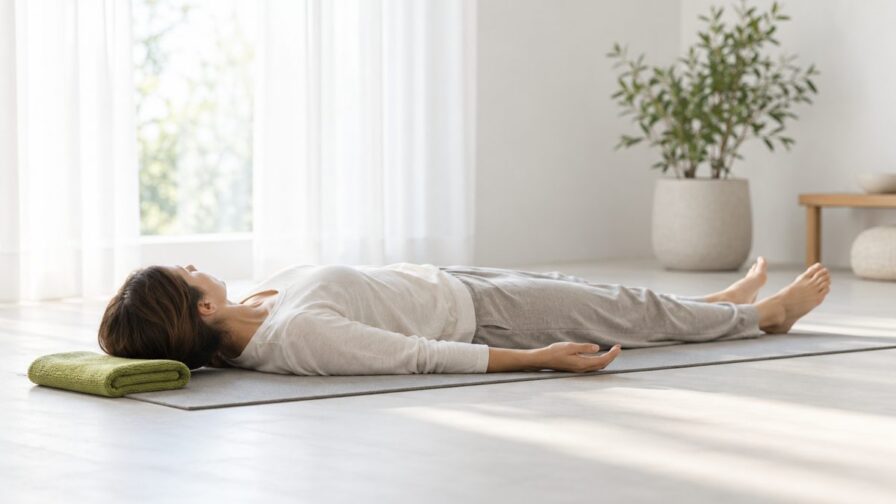
Sit or lie down so that your body is supported. Tense the muscles as you breathe in, for about a count of five, and release them completely as you breathe out, for about a count of three. After each group, stay relaxed for a few calm breaths and notice the difference.
- Calves. Breathing in for a count of five, point your toes away from you and feel the tension in your calves. Breathing out for a count of three, let go.
- Front of the shins. Breathing in, pull your toes toward you; breathing out, let go.
- Whole legs. Breathing in, tense your thighs and buttocks as if pressing your legs into the floor. Breathing out, let go.
- Arms. Breathing in, make fists and tense your arms up to the shoulders. Breathing out, open your hands and let go.
- Shoulders. Breathing in, raise your shoulders toward your ears; breathing out, let them drop.
- Face. Breathing in, squeeze your eyes shut, frown and press your lips together. Breathing out, release your forehead, eyes and jaw.
Keep your attention on the sensations. What does the tension feel like? What changes when you let go? Heaviness, warmth and a light tingling are normal sensations of relaxation.
Breathing and precautions
The “in for five, out for three” rhythm is my own version; it conveniently links breathing with tensing and releasing. Many classic instructions don’t tie breathing to a count this strictly. If counting feels awkward or you start to feel dizzy, breathe at your usual pace. The heart of the exercise is the contrast between tension and relaxation, not the exact count.
Tense your muscles noticeably, but not to the point of pain: about half your strength. If you have an injury, recent surgery or chronic pain somewhere, skip that muscle group or discuss the exercise with your doctor. If your calf cramps when you point your toes, stretch more gently or move on to the next step.
How to fit relaxation into your day
Before bed, you can combine relaxation with the “Lights Out” exercise: first let your body go, then dim your thoughts.
When you need a professional
See a psychologist or your family doctor if anxiety lasts for weeks, interferes with sleep, work and relationships, and the exercises relieve tension only briefly. A psychologist can help you understand what exactly keeps the anxiety going. Your family doctor will check for physical causes and, if needed, discuss medication.
New or worsening pain, numbness, or weakness in your arms or legs is a separate reason to see a doctor. If you have thoughts of death or self-harm, call 112 if you’re in immediate danger, or call the emotional support line at 116 123 (10:00–24:00). All contacts are collected on the emergency psychological care page.
Burnout test
Constant muscle tension, headaches and trouble resting often go along with burnout. The test helps you look at physical symptoms together with sleep, anxiety and responsibility. It doesn’t give a diagnosis. Other first-aid techniques are on the burnout page.
Frequently asked questions
Is progressive muscle relaxation the same as the Jacobson method?
Yes, it’s the same method. It was developed by the American physician Edmund Jacobson. It’s also called progressive relaxation or Jacobson’s relaxation technique.
Can I do relaxation at work?
Yes. You can go through all six muscle groups sitting in a chair, and do the short version with your shoulders and face even in a meeting, if no one’s looking. That’s one of the method’s main conveniences.
What if my anxiety grows during the exercise?
That sometimes happens when you notice for the first time how tense you are. Open your eyes, breathe at your usual pace, and shorten the exercise to two or three muscle groups. If your anxiety gets stronger every time, talk it over with a psychologist.
Does relaxation help you fall asleep?
Research shows that regular muscle relaxation often improves how people rate their sleep quality. But with chronic insomnia, relaxation alone is usually not enough: it’s worth discussing full insomnia treatment with a doctor.