
Cognitive biases
The IKEA effect: why what we make ourselves seems better than the same thing ready-made
A toy store sells wooden boats. You can buy one already assembled, or you can take a kit of six parts and put it together yourself. Eva took the kit and fiddled with it all evening: the mast went in only on the second try, and the little flag leans a bit. Her friend bought the same boat, but ready-made. When they put the boats side by side, Eva said: “Mine is still prettier.” And she was surprised that her friend did not agree.
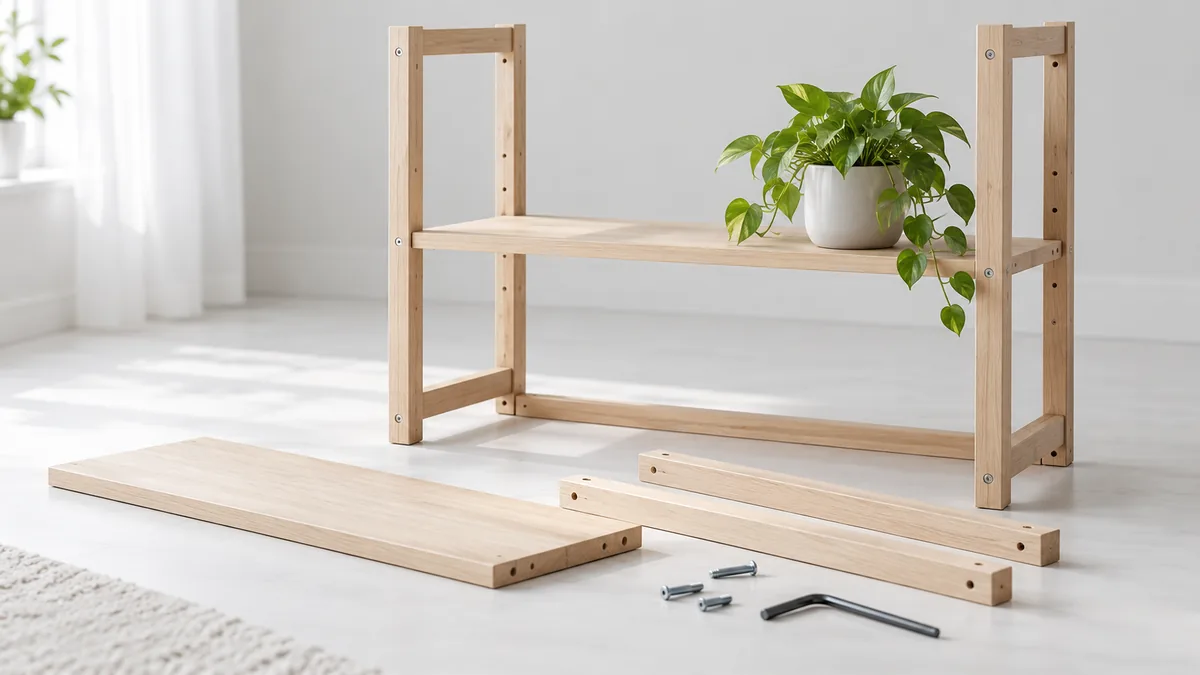
This is the IKEA effect: a thing we made or assembled ourselves seems more valuable than the same thing ready-made, even if it turned out imperfect. The name comes from the furniture store whose customers assemble the furniture themselves. An important detail: the effect appears only if we managed to finish the job.
Below, we look at what research has shown, where the love of our own work comes from, and where it gets in the way. In the middle of the article you will build a boat yourself in a game workshop.
Contents
In short: how the IKEA effect works
What the IKEA effect is
The effect was described by Michael Norton and his colleagues in a 2012 paper. It is titled “The IKEA effect: When labor leads to love.” In four studies, participants assembled IKEA boxes, folded paper figures, and built models from Lego. And they valued what they had made themselves more highly.
Two results are especially interesting. First: participants considered their own amateur creations almost as valuable as ones made by experts. And they expected other people to agree. Second: the effect appeared both in people who like to make things and in those who usually don’t.
But the love of our own work turned out to have a condition. If participants built a model and then took it apart, or ran out of time to finish, the effect disappeared. Labor led to love only when the job could be finished.
Later, other researchers tested the effect again, in a slightly different way. It held up: people were willing to pay more for what they had assembled themselves.
And in a 2018 study, the effect was tested in children. It began to appear at about five years old, the age when a child develops an idea of who they are. And for children of five or six, it did not matter whether the craft took a lot of effort or little.
How strong the effect is on average is hard to say honestly: we did not find a large review of studies that we could check against the original sources. The direction is clear: we value our own work more. How much more depends on the thing and on the person.
Try it yourself: the boat workshop
The game takes two or three minutes. Here is what will happen.
You are in a boat workshop. First you build a boat yourself from six parts: you put each part in place, tighten the screws, pick the color of the sails and the flag, and paint the sails. The workshop pays you in stars for the work.
Then we show you two boats, each on its own screen, and ask how many stars you are willing to give for each one. The slider starts empty so that it does not suggest any number to you. The deals are real: the stars leave your jar, and the boat goes on your shelf. At the end, we tell you what the trick was and what scientists found. Each new game goes a little differently.
What the game showed is further down, in “Why our own seems better.” If you have not played yet, play first.
What usually happens. In experiments, people valued what they had made with their own hands more than the same thing ready-made, and were willing to pay more for it.
When it is not a mistake. Loving what you made with your own hands is normal. The joy of “I did it” is real, and it is worth that evening. It becomes a mistake when we expect others to value our work as highly, or choose it over a better one only because it is ours.
Why our own seems better
When we look at something of our own, we see more than the thing. We see the evening it took and the moment when it finally worked out. Researchers name several possible reasons.
“I did it.” According to another paper by the same authors, a thing made with your own hands gives you the feeling: I can do things, I manage. It was this feeling that raised its value. When participants were helped beforehand to strengthen their belief in themselves, they valued their own creations less. And when that belief was shaken, people wanted more to make something with their own hands.
“It’s mine.” The authors of that study found that the effect is linked to the feeling “this thing is mine.” But “mine” alone doesn’t explain everything. In experiments with children, the feeling of ownership did not explain why crafts were valued more. The authors suggest that a thing we made becomes part of how we see ourselves.
Only what is finished. A model that was taken apart or left unfinished did not produce this love. It seems it is not the effort spent that matters, but that it led somewhere. A thing that turned out well is proof that we managed.
What the game showed
At the end of the game, your two prices sit side by side: how many stars you were willing to give for your own boat and how many for the ready-made one. The boats are of the same quality: the same six parts, the same screws, the same neat paint job. Chance picked the ready-made boat’s colors, the order, and the workshop’s prices. If you named a higher price for your own boat, it looks like the IKEA effect. Stars stand in for money here: in one of the later checks, scientists also looked at how much people were willing to pay for what they had assembled themselves. The deal itself, though, is our own invention for the game: the workshop picks a price in advance, and you pay it only if it is no higher than yours. Under this rule, your best move is to name your true price.
What the game can’t show. The stars are worth something only inside the game, and the boat on your shelf is a picture. Part of the gap may simply be taste: you chose your own boat’s colors, while chance chose the ready-made one’s. The first price can pull the second one along, so the order swaps in a new game. And a couple of minutes of building is nothing like fiddling with a mast all evening. So your result is a hint, not a test. If you don’t see the effect, it doesn’t mean you don’t have it in real life.
Where it gets in the way
Work. We see our own report, our own idea, our own way of doing things from the inside: with all the evenings and the solutions we found. Colleagues see only the result. Hence the hurt when an “obviously good” piece of work is rated with reserve. This is an everyday observation, but it follows from the experiments: participants expected others to value their creations as highly as they did.
Selling your own. When you sell something you made or repaired yourself, it is easy to name a price buyers won’t accept: you see the evenings of work, and they see only the thing. This is an everyday observation.
Home and hobbies. It is a pity to replace a wobbly shelf you assembled yourself with a sturdy one. It is a pity to throw out a sweater you knitted, even if you haven’t needed it for years. Sometimes that is lovely. Sometimes it makes us cling to an inconvenient thing.
The effect works in our favor, too. The joy of making something with your own hands is one of the reasons we want to make things at all. This is an everyday observation.
How to judge your own work more calmly
The IKEA effect is one of the biases on the cognitive bias map, in the section on how we judge people and ourselves. Next to it is the Dunning-Kruger effect: how we rate our own abilities.
Frequently asked questions
Is this the same as loving the things we already have?
They are close but different. The article on loss aversion describes an experiment with mugs: those who were given a mug asked for more than the others were willing to pay. There, the thing simply became theirs. With the IKEA effect, we also made the thing ourselves. The feeling of “mine” is part of it too, but, judging by the experiments with children, it doesn’t explain everything.
Is this the same as the sunk cost fallacy?
No. With the sunk cost fallacy, what holds us is what has already been spent and won’t come back. With the IKEA effect, we value the result of our own work. And, at least in children, the value did not depend on how much effort went in.
Does the IKEA effect only work with furniture?
No. In the experiments, people assembled IKEA boxes, folded paper figures, and built Lego models, and in each case they valued their own work more. The name comes from the store, but the effect is about making something yourself and finishing it, not about furniture.