
Anxiety
Social Anxiety: Why Brain Perceives People as a Threat
Does the thought of a presentation, a party, or even a simple phone call leave you in a cold sweat, wishing the ground would swallow you whole? Do you spend hours replaying past conversations, dissecting every word? The problem isn’t that you’re “shy” or “insecure.” The fear of communication isn’t a character flaw—it’s a glitch in brain’s ancient security system that perceives people as predators. Understanding this mechanism is the first step toward regaining control.

Contents
Key Takeaways
Why Every Interaction Feels Like an Exam
Imagine that every interaction you have is an oral exam. You’re an unprepared student surrounded by stern examiners who scrutinise your every word, gesture, and even your pauses. They’re just waiting for you to make a mistake. Sound familiar? “What will they think of me?”, “I’m about to say something stupid,” “It’s better to just stay quiet and not embarrass myself.” This internal monologue turns a simple conversation into torture.
This has nothing to do with your actual competence or social skills. It’s about our brain’s programming. For our distant ancestors, being exiled from the tribe was a death sentence. A loner couldn’t survive on the savannah. So, the brain developed a hypersensitive monitoring system: “Do they accept me? Are they judging me? Are they about to cast me out?” This program still runs in our heads today. Only instead of a savannah, it’s an office; instead of a tribe, it’s your colleagues in a meeting; and instead of exile, it’s an odd look or an awkward silence.
This isn’t a conscious decision; it’s an automatic reaction. brain perceives the possibility of social disapproval as a direct threat to survival. A key brain region responsible for this is the medial prefrontal cortex (mPFC), which is constantly busy thinking about ourselves and what others think of us. In people with social anxiety, this area is hyperactive. It endlessly runs through failure scenarios, burning a huge amount of mental energy. You haven’t even started talking, but you’re already exhausted.
Flight or Freeze: Three Automatic Reactions to a "Dangerous" Conversation
When the brain detects a threat, it has three basic action plans: fight, flight, or freeze. With social anxiety, these ancient instincts manifest in very specific ways. It’s crucial to understand that this is not your conscious choice but an automatic response triggered by the limbic system.
- Flight. The most obvious reaction. It’s not just the desire to leave a party where you don’t know anyone. It also includes more subtle forms of avoidance: burying your face in your phone to avoid small talk; crossing the street to avoid greeting an acquaintance; turning down a promotion because it involves public speaking. brain chooses short-term relief, even if it harms your career and life in the long run.
- Freeze. “My tongue was tied,” “My mind went completely blank.” This is the “freeze” response. In the wild, it’s a way to play dead so a predator loses interest. In a social context, the brain shuts down “non-essential” functions like creative thinking and complex speech. You can’t find the right words not because you’re unintelligent, but because your survival system has hijacked control and decided it’s more important to scan for threats than to be witty.
- Fight. This reaction is less common but still occurs. It can manifest as being overly defensive, aggressive, sarcastic, or argumentative. The person seems to be striking first to avoid being “attacked” with criticism. To others, it looks like a difficult personality, but in reality, it’s the brain’s clumsy attempt to defend itself from a perceived attack.
By recognising these patterns in your behaviour, you take a vital step: you start to see them not as your “flaws,” but as the workings of biological mechanisms. And unlike character traits, mechanisms can be worked on.
Why "Just Be Yourself" Is Terrible Advice
“Just be more confident!” “Picture everyone naked!” “Step out of your comfort zone!” If you could get rid of social anxiety with advice like this, psychologists wouldn’t exist. The problem is that these recommendations are addressed to the wrong part of the brain.
They appeal to your consciousness, to the neocortex—your rational, logical part. But the “Danger!” command comes from deep within the limbic system, from an amygdala that doesn’t understand the language of persuasion. It’s like trying to stop a fire alarm by politely explaining that there’s no smoke. The alarm doesn’t respond to words; it responds to sensor readings. So does amygdala.
Furthermore, trying to “brute-force” your way through it by following advice to “step out of your comfort zone” often has the opposite effect. You force yourself to go to a party, spend the whole evening in misery, and then beat yourself up for days for “failing” again. What does brain record? “Social contact = pain and failure.” The fear doesn’t diminish; it gets reinforced. This can lead to learned helplessness: the more you try, the more convinced you become that nothing works.
How to Tell Social Anxiety from Introversion
Introversion is a preference for how you recharge your energy. An introvert can communicate effectively, but it drains them, and they need time alone to “recharge.” Social anxiety (or social phobia) is an irrational fear and active avoidance. A person might genuinely want to connect with others but is unable to because of a paralysing fear of judgment and the accompanying discomfort.
What You Can Do Today
To start retraining brain, you don’t need to perform heroic feats. You need small, consistent, and correct actions. Here are three steps you can take today.
When to See a Specialist
Self-help is valuable, but sometimes the “internal alarm” is so out of whack that it can’t be fixed without outside help. You should consider consulting a psychologist if:
- Social anxiety is seriously interfering with your work, studies, or personal life.
- You’re turning down interesting opportunities (a promotion, a date, a trip) just because they involve socialising.
- You feel socially isolated and suffer from loneliness but can’t change the situation.
- Your attempts to cope on your own only lead to more stress and self-criticism, and you feel stuck in a loop that might be connected to other issues like depression.
In a consultation, we won’t try to “break” you or force you to “be brave.” We will work together to understand exactly how your anxiety system works and what specific, evidence-based methods can help recalibrate it. The goal is not to eliminate anxiety completely (that’s impossible and unnecessary) but to reduce it to a level where it no longer controls your life.
If you feel ready to understand the roots of your fear and start making a change, I’m here to help you on that journey.
Frequently Asked Questions
Can social anxiety be completely cured?
The goal of therapy isn’t to make you never feel nervous before a presentation again. Anxiety is a normal emotion. The goal is to reduce fear to a manageable level—to turn an all-consuming forest fire of panic into a controlled fire in a fireplace that doesn’t get in the way and can even help you focus.
Is medication always necessary?
In some cases, especially with severe anxiety or panic attacks, medication (like SSRI antidepressants) can be a useful temporary tool. It helps lower the overall “noise” level, making psychotherapy more effective. It’s like bailing water out of a flooded boat so you can start to repair it. The decision about medication is made together with a psychiatrist.
Are social anxiety and shyness the same thing?
No. Shyness is a personality trait, a discomfort in new situations that usually fades as you get used to them. Social anxiety disorder is an intense, paralysing fear of judgment that leads to significant distress and active avoidance of situations. It doesn’t just “go away on its own.”
Why am I afraid of online communication and phone calls too?
To brain, there’s little difference. Even without physical presence, the mere fact of being evaluated (an unclear tone of voice, a long pause before a reply in a chat, the sight of your own face on Zoom) activates the same threat centres in the amygdala. Your survival system is still afraid of rejection; the arena has just become digital.


The Social Radar: How Brain Scans for Threats in Faces
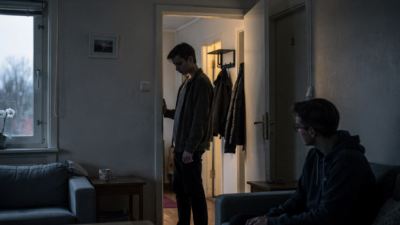
To survive in the tribe, you had to be a master at reading social cues. But what if that system malfunctions? Imagine you have a “social radar” in your head with the sensitivity cranked to maximum. It scans the faces of those around you for the slightest signs of disapproval: a subtle frown, a barely noticeable smirk, a glance away. To most people, this is just background noise. To your radar, it’s an alarm bell.
Neurobiological studies show that in people with social anxiety, the amygdala—our internal “smoke detector”—reacts to neutral or ambiguous facial expressions as if they were openly hostile. brain is literally screaming, “Danger!” even though, objectively, nothing is happening. The person across from you might just be lost in thought, but system has already interpreted it as judgment.
The mechanism is simple and ruthless. As soon as the amygdala sounds the alarm, a cascade of stress reactions begins. Cortisol—the stress hormone—is released into your bloodstream. Its job is to mobilise all the body’s resources for fight or flight. Your heart starts pounding, your palms get sweaty, your breathing becomes shallow. body is preparing for a physical confrontation. And all you’re trying to do is order a coffee or answer your boss’s question. It’s no wonder that after such an “interaction,” you feel completely drained. You weren’t just talking; you were mentally fighting for your life.