Burnout
How to fall asleep when your mind is racing: the “Lights Out” exercise
You lie down, close your eyes, and it begins. Who said what in the meeting. What you didn’t get done at work. What to say to your partner. Then the main thought joins in: “I have to get up early tomorrow, and I’m not asleep.” Your heart pounds, and sleep slips even further away. The “Lights Out” exercise can help you fall asleep when your mind is racing: instead of arguing with your thoughts, you dim them one at a time in your imagination.
The brain responds well to images. Anxiety is the best example: nothing has happened yet, but your brain has already painted a picture, and your body answers it with a real racing heart. You can use the same mechanism to your advantage. “Lights Out” is an exercise from my practice: I give it to people with burnout whose minds won’t switch off at night.
Contents
The short answer: how "Lights Out" works
Why won't your thoughts let you fall asleep?
During the day, tasks and conversations keep your mind busy. At night there are almost no outside signals, and everything unfinished comes to the front: chores, grievances, plans, fears. On top of that comes anxiety about sleep itself: “it’s already 1 a.m.,” “tomorrow I’ll be a wreck.” The harder you try to fall asleep, the more awake you get. The result is a loop that feeds itself.
With burnout, this loop is especially familiar. There’s no time to think during the day, so all the thinking moves into bed. I wrote in detail about how insomnia develops and why “I have to fall asleep” keeps you awake on the insomnia page. Here is one specific exercise for the moment when you’re already lying down and your thoughts won’t let go.
The control room: the exercise itself
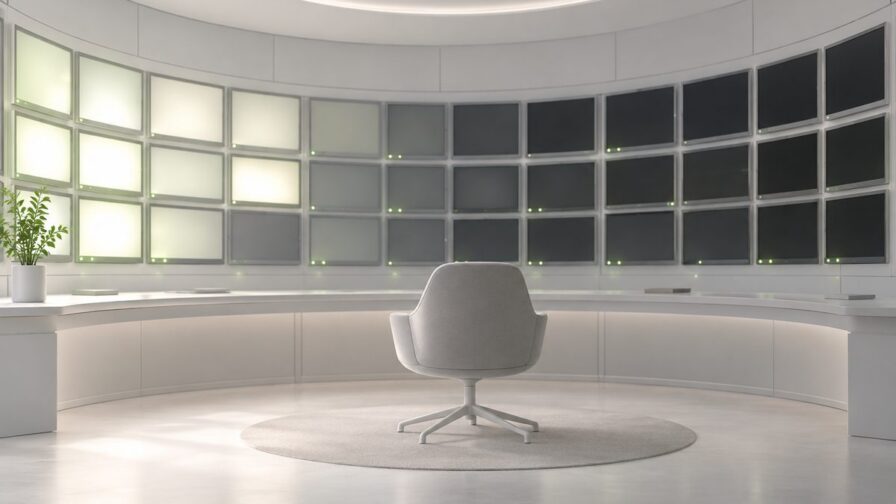
Close your eyes and imagine you’re the head of a control room, like the one at NASA. Rooms like this show up in movies about rocket launches: dozens of monitors, gauges, lights, switches. Everything is glowing and running. Give the picture time to load. Some people get it right away; others need a few minutes. Don’t worry: you’re not asleep yet anyway.
Your job as the person in charge is to shut the room down for the day. Soon your brain will get bored and toss up a familiar thought: about work, about relationships, even “I’m itchy” or “I need to roll over.” As soon as a thought arrives, picture it on one of the monitors. It might be a scene from your life, someone’s face, or just a blinking light.
Under your hand is the main switch, a big, heavy dial. You turn it smoothly, and the monitor slowly fades. The thought grows quieter along with it. Your brain offers the next one, and you do the same. And so on, one by one, until the room goes dark and the stream dies down.
Why an image helps more than a fight
Controlling thoughts directly is hard. Try not to think about a white bear right now. But we can control what happens in our imagination. If you tie a thought to an image that can be switched off, there’s something concrete to turn off. That’s how I explain this exercise to clients. It’s an explanation from practice, not a proven brain mechanism.
The closest study I know of is a 2002 experiment with 41 people with insomnia. One group kept their attention on a calm mental image before sleep, another distracted themselves the way they usually did, and a third got no instructions. The imagery group fell asleep faster and had fewer unpleasant thoughts before sleep. Ordinary distraction didn’t have that effect.
That doesn’t prove the control room in particular works. But it supports the general idea: filling your attention with an image may help more than trying to force thoughts out or counting sheep.
How to adapt the image to yourself
You don’t have to fit yourself to the exercise. Fit the exercise to yourself. If you rarely watch movies and a space center means nothing to you, pick a different room. Some people picture the control panel of a power plant on a hill above a city at night: each thought is a noisy neighborhood down below, and you switch off the neighborhoods one by one until the city goes quiet. Others picture an airport control tower or an old theater where the lamps go out one at a time.
One thing matters: the image should have separate sources of light or noise that you turn off gradually. A sharp click works worse than a slow turn of the dial. A slow action slows you down in itself.
Many people notice the first results after about two weeks. In my observation, some people eventually get an interesting effect: after a month or a month and a half of regular practice, just picturing the room is enough for sleep to come faster. The ritual becomes a sleep habit. That’s an observation, not a promise: for some, the exercise works from the first night; others need weeks.
Step by step tonight
The exercise works better when nothing else is getting in the way of sleep either: darkness, coolness, screens put away early. More on that in the article on sleep hygiene for burnout.
When you need a doctor's help
See your family doctor if sleep problems have lasted several weeks, happen at least three nights a week, and get in the way of your day. There’s an effective method for chronic insomnia: cognitive behavioral therapy for insomnia. If you have persistent exhaustion, anxiety or low mood, medication may also be an option, chosen by your family doctor or a psychiatrist.
Don’t put off seeing a doctor if people close to you notice loud snoring and pauses in your breathing during sleep, or if you fall asleep during the day in inappropriate situations. If you have thoughts of death or self-harm, call 112 if you’re in immediate danger, or call the emotional support line at 116 123 (10:00–24:00). All contacts are collected on the emergency psychological care page.
Burnout test
Thoughts that keep you awake often come with daytime fatigue, irritability and trouble concentrating. The test helps you see where the load is heaviest. It doesn’t give a diagnosis. The other first-aid techniques are collected on the burnout page.
Frequently asked questions
What if I can't picture anything?
Start simple: one monitor and one dial. The picture doesn’t have to be bright or detailed; a vague image is enough. If visual images really aren’t your thing, you can imagine sound instead: the thought is a radio, and you slowly turn the volume down.
I fall asleep before I finish the exercise. Is that normal?
That’s the best possible outcome. The exercise is there to help you fall asleep, not to switch off every last monitor.
A thought fades and comes right back. What should I do?
Dim it again. A thought coming back doesn’t mean the exercise isn’t working: every repetition is practice. Over time, thoughts usually come back less often.
Can I do this exercise during the day?
Yes, if you need to calm down somewhere quiet. But during the day, short eyes-open techniques are usually more convenient, such as returning to the here and now through your senses.