
Articles
Constant Guilt: A Sign of Conscience or a Crushing Burden?
Does saying “no” to a request leave you thinking, “I should have helped”? Does taking a break turn into self-criticism: “I’m a bad employee while others are working hard”? Sound familiar? Perhaps you ask yourself, “Why can’t I just relax?” The problem isn’t your conscience. It’s a glitch in the neural networks of brain that regulate self-esteem and social monitoring. This isn’t a moral compass; a healthy mechanism should guide behaviour, not become shackles. This is an unnecessary burden you can—and should—learn to set down.

Contents
Key Takeaways
Why Guilt Lingers: The Brain's "Broken Alarm"
This is roughly how chronic guilt works. It’s not a character flaw or an “overly sensitive conscience,” but a system malfunction. In its normal state, guilt is a useful tool for regulating our behaviour. Healthy guilt is an evolutionary mechanism that helped our ancestors maintain social bonds and survive in a group. It signals: “Your actions could lead to being cast out from the tribe, which is dangerous. Correct your course.”
The problem arises when this “alarm system” breaks. Several brain structures are responsible for this process, primarily the anterior cingulate cortex (ACC)—our internal “error detector.” Think of it as a guard posted at the border between what you do and what you “should do.” When this border becomes blurry, the guard starts seeing threats everywhere.
The ACC activates when we realize our actions diverge from our goals, norms, or the expectations of others. It works in tandem with the amygdala, the emotion-processing centre that generates anxiety and fear. This is an ancient system: in the face of a real threat, it saves our lives. But when it triggers in response to a phantom threat, it becomes a source of suffering.
In people prone to chronic guilt, the ACC becomes hyperactive. It starts seeing “errors” everywhere: you said the wrong thing, thought the wrong thing, didn’t do enough, disappointed someone’s unspoken expectations. The brain gets trapped in a vicious cycle:
1. The ACC detects a perceived “error.”
2. The amygdala generates emotional discomfort—that oppressive feeling of guilt.
3. The prefrontal cortex tries to find a reason for this discomfort and, finding no real transgression, engages in an endless internal dialogue: “I should have done it differently,” “I’ve ruined everything,” “What will they think of me? Maybe I really am a bad person.”
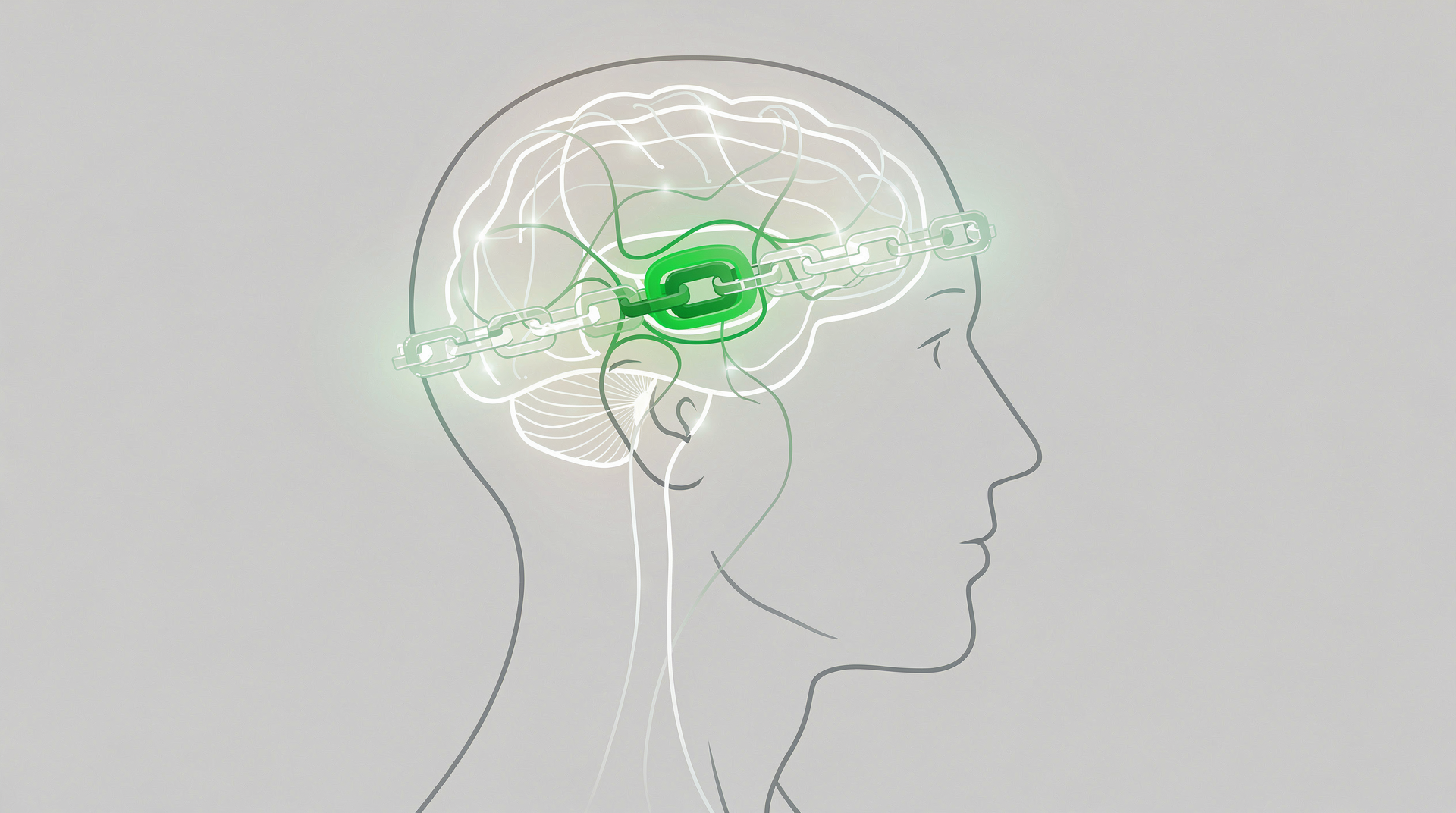
The mechanism works like a self-reinforcing chain. When the ACC is activated too often, it can physically change. Neurons in this area increase their synaptic connections, meaning they become better and faster at firing. This phenomenon is called synaptic potentiation, and it means one thing: the more you experience guilt, the easier it becomes for brain to generate that feeling. This isn’t about willpower; it’s biology.
As a result, a system designed for quick social course-correction turns into a machine for self-torture. You carry a heavy weight not for actual wrongdoings, but because of a “bug” in your neural network settings. This isn’t your moral failing; it’s a feature of brain’s functioning that can and should be recalibrated.
The Roots of Toxic Guilt: Childhood "Programming" and Perfectionism
Imagine brain is a forest, and your frequent thoughts and reactions are paths. The more you walk a single path, the wider and more defined it becomes. The vegetation gets trampled, the ground compacts. Over time, the path becomes a broad road, and turning off it requires conscious effort. Toxic guilt is just such a well-trodden road in your neural tissue.
Here are the main factors that pave this road:
1. An upbringing based on guilt and shame. If, as a child, you were regularly made responsible for your parents’ moods—”Mum is upset because you got a bad grade,” “Don’t cry, you’re giving Dad a headache”—brain learns a dangerous formula: “Others’ negative emotions = my fault.” As an adult, you automatically assume responsibility for your boss’s disappointment, your partner’s bad mood, or your child’s tantrums. The mechanism is simple: the child unwillingly becomes an emotional shock absorber for the adults, and their brain wires this role as the norm. Later, this neural program triggers reflexively, without conscious thought.
2. High expectations and perfectionism. “You have to be the best.” “A ‘B’ is not a real grade.” When the bar is set impossibly high, any deviation from the ideal is perceived as a failure. The perfectionist’s brain, like a strict auditor, searches for the slightest flaws—and finds them. An imperfectly executed project, a not-spotless apartment, an extra five minutes of rest—all become reasons for self-flagellation. The formation mechanism is simple: when the criteria for success are unattainable, the brain stops expecting success and switches to an error-detection mode. This isn’t ambition; it’s a defence mechanism: if I find myself guilty first, others can’t catch me off guard.
3. Social and cultural norms. Many cultures, particularly in post-Soviet regions, are steeped in the idea of self-sacrifice. “You should think of others, not yourself,” “Be patient, be more modest.” These attitudes create fertile ground for guilt over any attempt to put yourself first, care for your own comfort, or say no to a request. Society says, “Self-care = selfishness,” and the brain accepts this as a working hypothesis.
As a result of these processes, a habitual interpretation schema is formed. The brain becomes so accustomed to responding to any life setback with self-blame that it becomes its default setting. It’s no longer a conscious choice but an automatic response, deeply ingrained in the structure of your neural connections. Changing this is possible, but it requires time and conscious practice.
"Faulty Accounting": Guilt Over Rest and Others' Problems
This is like a glitch in your internal “social accountant.” Normally, our psyche strives for balance: “If I receive something, I must give something back.” This is the basis of fairness and mutual support. But with irrational guilt, this mechanism malfunctions. You feel indebted even when you haven’t borrowed anything.
The mechanism here lies in a phenomenon known as cognitive dissonance. This is the intense psychological discomfort that arises from holding conflicting ideas in your mind. For example: “I am a good person” and “Other people are suffering, and I am not.” To resolve this tension, the brain seeks a simple explanation. And the simplest one is to blame yourself.
“If I feel guilty for taking a break, it means I’m not so selfish; I’m a good, empathetic person. If I feel guilty for surviving, it’s as if I am acknowledging the injustice of what happened.”
This is an illusion of control. By accepting blame, a person unconsciously tries to reclaim agency in a chaotic and unjust world. The mechanism works like this: the brain’s default mode network (which is active when we’re not focused on a task and are thinking about ourselves and others) receives a signal of injustice. The prefrontal cortex tries to explain it, and the most accessible explanation is “it’s my fault, I could have prevented it.” Although you logically understand this isn’t true, the emotional centre (the limbic system) has already been activated, and trying to rationally explain away the dissonance takes energy. It’s easier just to feel guilty.
This kind of guilt serves no useful purpose. It helps neither you nor those you supposedly feel “guilty” towards. It’s simply an energetic black hole that drains your strength and prevents you from enjoying life.
Healthy Guilt vs. Toxic Guilt: What's the Difference?
Imagine you scratch someone else’s car. If you feel guilty, it’s natural: “I caused damage, I have to make it right.” This feeling is proportional to your action and motivates you to take steps—apologize, pay for the repair. And once you’ve done that, the feeling of guilt subsides. This is healthy guilt. It is focused on correcting a specific action.
Now imagine this: you’re stuck in traffic, running late for an important meeting, and you start berating yourself: “I’m late, everyone will think I’m irresponsible, I’ll be fired, I’m terrible.” Objectively, you could do nothing about the traffic. Your guilt is disproportionate to the situation, it doesn’t lead to a concrete solution (you can’t magically clear the traffic), and it just traps you in a cycle of self-blame. Or you said no to a colleague who needed help because you have your own urgent deadlines, and now you can’t sleep, thinking “I’m so selfish, I let them down.” Even though you acted reasonably, the guilt is overwhelming. This is toxic (or neurotic) guilt. The difference isn’t in the intensity of the feeling but in its source and function.
Healthy Guilt:
– Focuses on the action: “I did/didn’t do X.”
– Proportional to real harm: Matches the objective damage caused.
– Motivates action: Pushes you to fix the situation, apologize, or make amends.
– Fades after correction: Disappears once the situation is resolved.
Toxic Guilt:
– Focuses on identity: “I am a bad person.”
– Often baseless or disproportionate: Unrelated to a real transgression or wildly out of scale with it.
– Traps you in self-blame: Offers no way out, plunging you into endless rumination without a constructive solution.
– Destroys self-esteem: Constantly undermines your self-confidence.
Understanding this difference is crucial. Healthy guilt is our internal social navigator, helping us correct our course. Toxic guilt is a broken navigator that insists “you’re on the wrong path” even when you’re headed in the right direction, leading to self-destruction. It’s less a moral compass and more a symptom of an internal conflict and a faulty neural alarm system.
What to Do Today to Loosen Guilt's Grip
1. Conduct a “Guilt Audit.”
The moment you feel that familiar pang of conscience, stop and ask yourself three questions. Write down the answers:
– What specific harm did I cause with my action (or inaction)?
– Is this harm real, or does it exist only in my head, based on expectations (mine or someone else’s)?
– If the harm is real, what specifically can I do to fix or compensate for it?
This practice shifts brain from emotional, automatic mode (the amygdala is active and dictating the initial response) to analytical mode (the prefrontal cortex asks questions and seeks facts). The mechanism works like this: when you write down the answers, you activate the language centres in your left hemisphere. This literally and physically reduces activity in the amygdala. You break the cycle of self-blame not with willpower, but by shifting neural activity.
2. Implement a “Responsibility Separation Mantra.”
Chronic guilt often stems from blurred boundaries. You feel responsible for the feelings, reactions, and choices of other people. Start consciously handing their responsibility back to them. When you catch yourself thinking, “He’s upset because of me,” say to yourself, either silently or aloud: “His feelings are his area of responsibility. I am responsible for my words and actions, but not for his interpretation of them.”
At first, this will feel selfish—that’s because blurred boundaries have become your familiar world map. The mechanism is this: by repeating this phrase, you are retraining brain on which neural networks to activate in response to a specific trigger. Each repetition strengthens the new connection. It works more slowly than you’d like, but it works—provided you are consistent.
3. Schedule an “Act of Self-Compassion.”
Guilt is a form of self-directed aggression. To break this pattern, you need to counter it with the opposite action: self-care. When guilt is particularly strong, don’t punish yourself. Instead, do something small and kind for yourself: make a nice cup of tea, listen to your favourite music for 10 minutes, go for a short walk. This will reinforce a new pattern in brain: that discomfort can be met with support, not self-attack.
The mechanism is this: actions shape emotions just as effectively as emotions shape actions. When you care for yourself in a moment of pain, you activate systems responsible for safety and attachment (the parasympathetic nervous system). This is not just a “good feeling”—it’s a literal change in your hormonal state. Over time, these small acts retrain your stress response system.
These steps won’t eliminate guilt instantly, but they will begin to create new, healthier “pathways” in brain. With each attempt, it will become easier to turn off the familiar road of self-blame. It’s not an overnight result, but a real process of rewiring your neural circuits.
When to See a Specialist
You should consider seeking a consultation if you notice that:
– Guilt dictates your decisions in relationships, at work, and in life in general.
– You find yourself constantly apologizing, even when you’ve done nothing wrong.
– You can’t say no to requests for fear of feeling guilty.
– Guilt prevents you from resting, enjoying your successes, and taking care of yourself.
– Self-criticism and self-blame have become a constant background noise you can’t escape.
In a consultation, we won’t be looking for who to “blame” in your past. We will focus on the mechanisms that sustain this state here and now. Together, we will figure out which neural “programs” are forcing you to carry this burden and develop concrete, science-based strategies to reconfigure them. You don’t have to handle this alone.
If you are ready to understand the roots of your guilt and reclaim your right to a life free from constant self-judgment, you can book an online consultation or a face-to-face session in Tallinn. In times of acute crisis, emergency assistance is available.
Frequently Asked Questions
Can you get rid of guilt completely?
No, and you wouldn’t want to. Healthy guilt is an important social regulator. The goal of therapy is not to amputate it, but to “recalibrate” it: to eliminate irrational, toxic guilt while leaving the functional, appropriate guilt that helps you grow without destroying you.
Why do I feel guilty when I'm resting or doing nothing?
This is a classic example of neurotic guilt, born from the belief that “my value is equal to my productivity.” This “programming” makes the brain perceive rest as an “error” or a “theft” of time from more important tasks, triggering the habitual self-blame response. It’s not a moral failure; it’s a learned reflex. brain simply hasn’t learned to distinguish between “laziness” and “necessary recovery.” Unlearning this takes time and conscious practice.
How can I tell the difference between guilt and shame?
They are related but different feelings. Guilt says, “I did something bad.” Shame says, “I am bad.” Guilt focuses on a specific action that can be corrected. Shame attacks a person’s core identity, creating a desire to hide and disappear. Chronic guilt often escalates into toxic shame, which is why it’s important to distinguish between them and stop the process early on.
Can a constant feeling of guilt be a symptom of depression?
Yes, very often. Excessive or inappropriate guilt is one of the key diagnostic criteria for major depressive disorder. If your guilt is accompanied by apathy, loss of energy, anhedonia (the inability to feel pleasure), and sleep disturbances, it’s a strong reason to consult a specialist. These symptoms often reinforce each other: depression breeds guilt, and guilt deepens depression.