Burnout
Why vacation doesn't fix burnout
«Just a bit more — I’ll sleep it off on vacation and everything will pass». Often after two weeks at the sea you return wrecked, as if you never left. Vacation doesn’t fix burnout — it’s not about «bad rest». Burnout follows different rules than fatigue: the nervous system stays in readiness mode, and swapping palms for a sofa doesn’t change that.
We’ll look at how vacation differs from recovery, what happens in the brain, and what to do instead of «just resting». More on the burnout page.

Contents
Key points
Fatigue vs burnout: why vacation «works» only for the first
Fatigue is the normal price of load. You worked a lot, slept little — by evening you’re «empty». Weekend, vacation, sleep — and you’re back in shape.
Burnout is different: you sleep eight hours, rest two weeks — no energy. Returning to work brings disgust, not mild sleepiness. «Maybe I’m just lazy?» — no, it’s not laziness.
Metaphor: fatigue is a dead battery, burnout is a charger that can’t keep up. The brain saves energy: the nervous system stays on alert, resources go to background readiness, not recovery. Simplified — not laziness, but overload. Mitochondria and ATP in chronic fatigue research remain debated; the image is clear: one trip without changing load rarely «fixes» the system.
Vacation removes external deadlines. With burnout, internal tension stays: the body won’t switch to parasympathetic («rest and digest»). Reducing load and recovery are different processes. More: «Burnout or fatigue».
Why vacation doesn't restore the brain with burnout
«Lying under palms, but everything spins in my head». Vacation doesn’t restore the brain because the nervous system stays on alert: even without external stressors the prefrontal cortex won’t close task «tabs». The body rests on the beach — the inner dispatcher never switches off, and scenery alone isn’t enough.
Metaphor: a car ran at the limit for long. You drove into the garage and turned off the engine — but it’s still hot, the knock didn’t stop. Stopping isn’t repair. Same on the beach: formally «not at work», inside — the dispatcher never switched off.
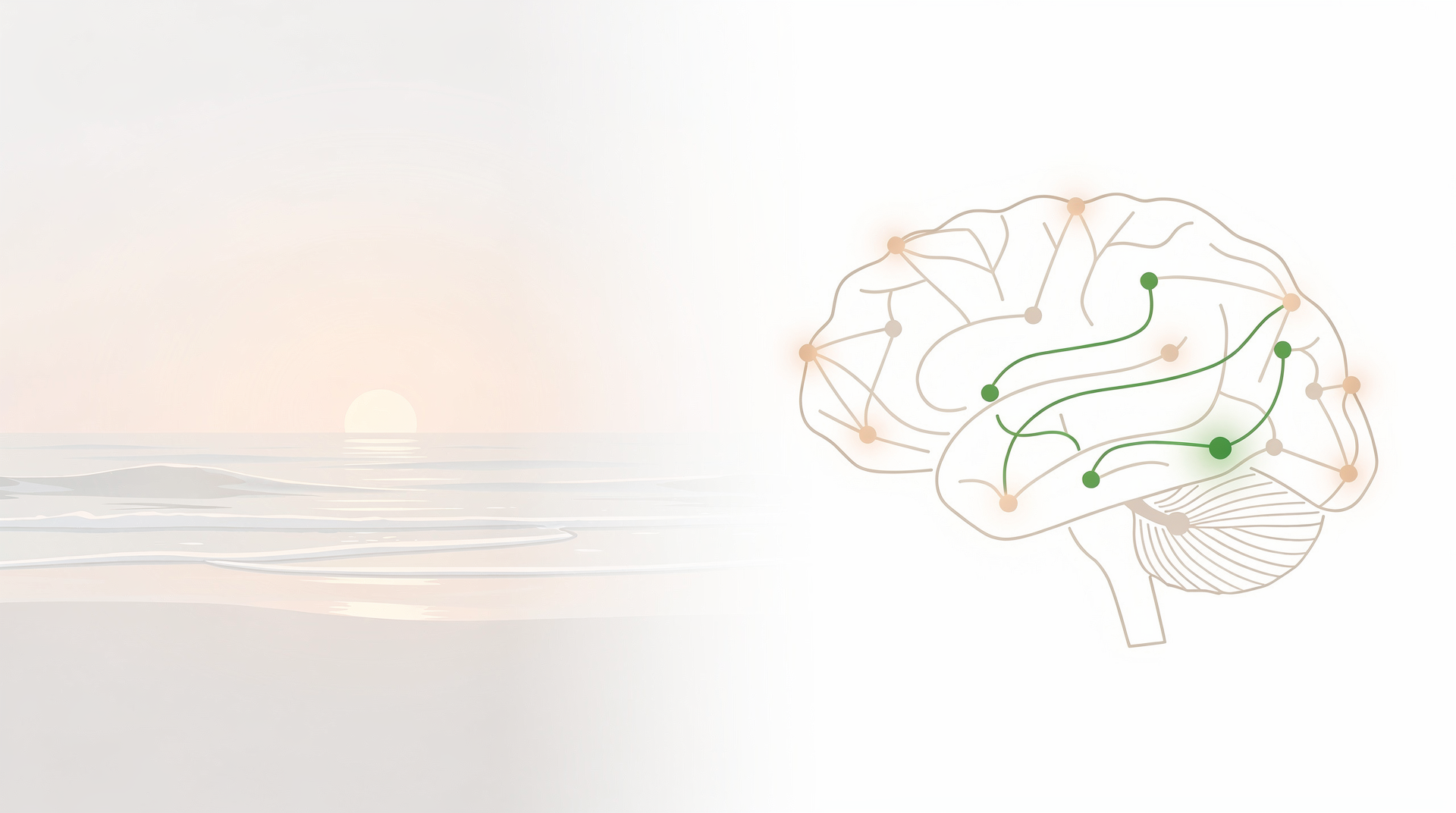
Chronic stress reshapes the hypothalamic-pituitary-adrenal axis. Short-term cortisol helps you stay alert; after months of overload regulation changes — burnout studies find, among other things, a lowered morning cortisol spike (Oosterholt et al., 2015). The prefrontal cortex works worse: won’t archive tasks, loops anxieties under the umbrella.
In course metaphor, ATP — cellular fuel — goes to background anxiety and «combat readiness», not rest. Even under an umbrella the brain burns resources on unfinished tasks. Hence the paradox: vacation happened, insomnia stayed — overlaps with «Sleep but no energy».
That’s why «I did nothing for two weeks» ≠ «I recovered». The body lay still — the nervous system didn’t enter energy accumulation mode. Without that switch, vacation stays a calendar pause, not repair. Slow-wave sleep may stay short — the brain won’t «pack» daytime events into long-term memory.
Three reasons «vacation didn't work»
1. Same environment after vacation. Toxic boss, overload, chaos — two weeks off won’t fix that. «Tomorrow back to hell» — by mid-vacation the brain already prepares defense. Anticipation of return raises anxiety. The amygdala can’t tell real threat from memory of a toxic meeting.
2. You don’t switch off — even without a phone. On the beach without email you still loop tasks, mistakes, deadlines. Not weak will — an exhausted prefrontal cortex can’t archive tasks. Brain like a computer low on RAM: work window closed, processor still loaded with background processes.
3. Broken regulation. Deep burnout disrupts balance of serotonin, dopamine, noradrenaline. The brain responds worse to «feel-good» hormones and sharper to stress. You can’t turn off anxiety with a simple «rest» — targeted recovery is needed, sometimes with a psychologist.
If you recognize all three and after every vacation there’s a rollback in days — look at nervous system state, not «bad vacation». Question: «What did I feel on the last vacation day — joy or dread before Monday?» The answer is often telling.
What to do instead of «just rest»
See where your energy goes
«Vacation didn’t help» is often the first signal it’s not laziness. The test doesn’t diagnose — it shows which of four scales is overloaded: sleep, anxiety, responsibility, body.
Take the burnout test · ~7 min · 4 scales · result immediately.
On the burnout page — stages, mechanisms, and what actually helps the brain without waiting for vacation.
FAQ
How long to rest with burnout?
Lowering load and recovery quality matter more than vacation length. There’s no single timeline — see ranges by severity in «How long recovery takes». Boundaries, sleep, less control, sometimes therapy — not a substitute for vacation, but what makes the effect last.
Does changing jobs help?
If the environment is toxic — yes, a necessary step. But if patterns (perfectionism, hyper-control) are yours, they’ll repeat elsewhere. Job change without «regulation repair» is like vacation without switching off your head.
Why am I tired again after two days back?
The brain returned to the same stressors and re-enabled the old mode. Dread before Monday often builds during vacation — the rest effect often fades within a couple of days after return. That’s burnout with unchanged load, not «short vacation».
Can I cure burnout myself?
Early stage — sleep, boundaries, less load often help. When regulation is broken and rest won’t restore — hard to exit alone. That’s biology, not weakness.