
Articles
Is Anxiety a Sign of Weakness or a Natural Brain Response?
Persistent anxiety isn’t a character flaw or your fault; it’s a mechanism brain uses to try and protect you, often overzealously in the modern world. It operates on instincts honed millions of years ago when every shadow could hide a predator and any uncertainty spelled mortal danger. Today, the “predators” have changed, but the biological alert system remains the same, frequently triggering without any real threat.
Table of Contents
Key Insights
Anxiety as the Brain's Protective System
Imagine yourself on the savannah, where every rustle in the bushes could signal an approaching predator. What did brain do then? It instantly switched to maximum alert: hearing sharpened, vision became acute, muscles tensed, heart pounded, and blood rushed to your limbs. You didn’t consciously decide, “Oh, I’m going to be scared now!” This was an automatic, life-saving reaction, giving you crucial seconds to flee or prepare to fight.
In this metaphor, brain is an ancient guardian still working from old instructions. A small structure deep within the brain, the amygdala, is responsible for potential threats. It’s the primary danger scanner. Upon receiving a signal (real or imagined), the amygdala triggers a cascade of physiological reactions. This isn’t a sign of weakness; it’s a biological program that has saved lives for millennia.
The problem is that for our “guardian,” the modern world is still the savannah, but the predators are different. Work deadlines, unpaid bills, the news feed, social pressure, or even a message on a messenger app – all can be equivalent to a lion’s roar for the amygdala. It doesn’t differentiate between a real physical threat and an abstract social one. This isn’t your personal weakness; it’s a limitation of an ancient system operating in entirely new conditions.
How the Brain "Produces" Anxiety: From Threat to Reaction
Imagine a miniature control center operating within your head. As soon as information about a “problem” arrives (uncertainty, bad news, a difficult conversation), this dispatcher—the amygdala—is instantly activated. Its first reaction is to sound the alarm, which it does by flooding your bloodstream with stress hormones, primarily cortisol and adrenaline. These substances act like a “nitro boost” for your entire system.
Adrenaline sharply increases your heart rate, dilates your bronchi to allow more oxygen intake, and mobilizes energy reserves. Cortisol keeps body in a state of heightened readiness, suppressing functions less crucial at that moment, such as digestion or the immune system. In ancient times, this was ideal: you received an immediate burst of energy to run or fight.
In a modern context, this mechanism becomes problematic. Threats rarely demand physical escape or combat. Instead, you’re sitting at your desk, trying to concentrate, but brain and body have already received the command to “escape.” It’s like a constantly blaring alarm that triggers for passing cars, not just for an actual intruder.
Ancient neurobiological pathways, designed for survival, are constantly activated unnecessarily, leading to a chronic expenditure of ATP (adenosine triphosphate) – the cells’ primary energy molecule. This “idle” burning of energy exhausts the brain and body, preventing them from recovering. body, like an engine constantly running at maximum RPMs, inevitably requires major overhaul. This isn’t fatigue you can overcome with willpower; it’s a physiological depletion of resources.
Therefore, anxiety isn’t just “nerves”; it’s a complex, ancient reaction that, in current conditions, often misfires and requires “reprogramming.”
Why Do You Feel the Full Force of Anxiety? (On Physical Manifestations)
When the brain releases cortisol and adrenaline, these hormones don’t just stay in your head. They spread throughout your entire body, affecting every organ and system. Your heart starts pounding faster, breathing quickens and becomes shallow, muscles tense, digestion slows down, you might experience a dry mouth, and sometimes tingling in your extremities. It is these physiological changes that you perceive as the unpleasant physical symptoms of anxiety.
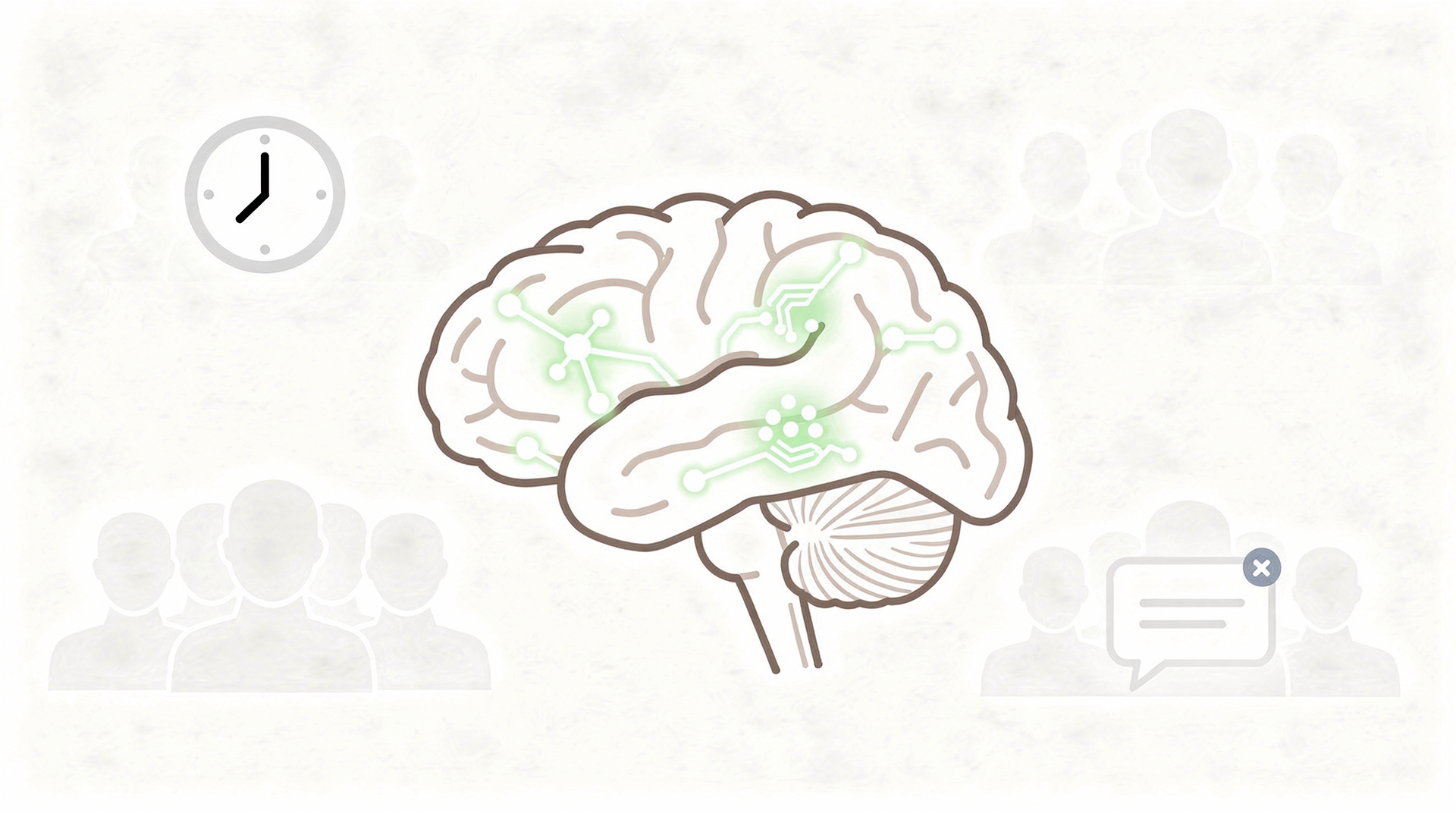
These symptoms are not “all in your head,” as others sometimes suggest – they are real, physically palpable manifestations of the activation of the sympathetic nervous system, the part of the autonomic system responsible for “fight or flight” responses. This complex of physical reactions is the very mechanism of anxiety, designed to prepare the body for emergency action. For example, blood rushing to large muscles (legs, arms) ensures readiness for escape. And slowed digestion allows energy to be redirected from less important functions to vital ones.
When anxiety becomes chronic, these bodily sensations don’t disappear; they evolve into constant tension. body cannot remain indefinitely in “battle mode” because the sympathetic nervous system – the body’s “accelerator” – is constantly active, preventing the “brake” (the parasympathetic nervous system) from restoring balance. This leads to chronically elevated levels of cortisol and adrenaline, which over time causes systemic malfunctions: from chronic headaches (due to tension in the neck and head muscles), digestive problems (irritable bowel syndrome), and a feeling of constant fatigue to a weakened immune system.
The body, like an engine running at its limit, inevitably requires major overhaul. Understanding these mechanisms allows you not to blame yourself but to see that body is reacting to brain commands that can be reconfigured.
"Overthinking": Cause or Consequence of Anxiety?
“What if…”, “I should have done it differently…”, “They probably thought that…” – these thoughts swirl in all our heads. But for someone with heightened anxiety, this stream becomes exhausting, endless, and seemingly insurmountable.
Many think, “I’m anxious because I think about everything so much.” But this isn’t the cause; it’s more likely the consequence. brain is launched into problem-solving mode but is running on empty.
When the amygdala “ignites” anxiety, it also signals the prefrontal cortex – the part of the brain responsible for planning, decision-making, and rational thought. The idea is for the “intellect” to join the search for a solution. The amygdala says, “Danger!”, and the prefrontal cortex tries to respond, “How do we fix this?” The problem is that external threats have become too complex, and information too vast for the brain to find a “correct” solution instantly.
Thus, you fall into a trap: body is in “fight or flight” mode, and brain tries to find a way out, constantly reviewing options, analyzing the past, and attempting to predict the future. This mental “noise” only amplifies anxiety because every new “what if…” is perceived by the amygdala as a new potential threat, which, in turn, generates even more thoughts. This isn’t a helpless state where you’re simply “overthinking”; it’s a specific neurochemical reaction that can be interrupted and rechanneled.
How to Distinguish "Normal" Anxiety from Excessive Anxiety?
So, how do you know when your “guard dog” is just barking at the postman, and when it’s keeping you awake and interfering with your life? It’s not a question of intensity, but of context and control.
Normal anxiety is feeling worried before an important exam or job interview: it mobilizes you, helps you prepare. It’s like an alarm that only goes off for a real burglar. You feel agitated, but it’s appropriate for the situation and helps you act. After the event or solution of the problem, the worry recedes.
But if you’re constantly worrying about trivial things – “What if I didn’t turn off the iron…” or “What if they don’t understand me…” – and this worry lives its own life, unrelated to any real threat, then it’s excessive anxiety. brain starts seeing “predators” where there are none, triggering the “fight or flight” reaction non-stop. This isn’t your caution or responsibility; it’s a system malfunction called generalized anxiety disorder – when your internal guardian is overly zealous and hinders your life rather than protecting it.
Signs of excessive anxiety:
- Worry is present most of the day, more days than not, for months.
- You cannot control or stop the stream of worrying thoughts, even when you know they are unfounded.
- Physical symptoms persist: tension, insomnia, fatigue, inability to concentrate.
- Anxiety impacts your work, relationships, and ability to enjoy life.
- You avoid situations that might trigger anxiety, narrowing your world.
If you recognize yourself in this description, it’s not a sign of your weakness, but a signal that the system needs attention.
What Can You Do Today to Reduce Anxiety?
Our goal is not to suppress anxiety, but to redirect the signal into a constructive channel or give brain a break. Start with these steps:
1. Turn off extra stimuli. For an hour, skip news and social feeds — amygdala gets fewer false alarms.
2. 4–4–6 breathing. Slow inhale, pause, long exhale — activates the parasympathetic nervous system.
3. Move for 10–15 minutes. A walk or stretch burns excess adrenaline and cortisol without fighting thoughts.
4. 5-4-3-2-1 grounding. Name 5 things you see, 4 sounds, 3 sensations — return attention to “now.”
5. A small win. One simple step under control (an email, clearing your desk) — a signal to the brain: “I’m not helpless.”
When Should You Seek Professional Help?
If anxiety lasts for weeks most of the day, interferes with work and sleep, or you start avoiding situations — it makes sense to unpack the mechanism with a psychologist. Book an online consultation or in Tallinn. In an acute crisis, see emergency psychological care.
Test Yourself: Take an Anxiety Assessment
A short anxiety assessment helps gauge the scale — not a diagnosis, but a guide for next steps.
Frequently Asked Questions
Is anxiety a sign of weakness?
No. It’s an ancient protection system that often misfires in modern conditions without real danger. Weakness isn’t the issue — biochemistry is overloaded.
Why does my body react when I "know it's fine" in my head?
The amygdala reacts faster than conscious thought. A worry about a possible problem can trigger the same cascade as real danger.
Can I get rid of anxiety completely?
No, and you don’t need to. The goal is to lower intensity and frequency so anxiety stays a useful signal, not background noise.
When do I need a psychologist?
When self-help doesn’t shift things for months, you have panic attacks, or avoidance narrows your life — consultation helps find triggers and techniques for nervous system.
The information in this article is for self-education and does not replace professional diagnosis or consultation. If anxiety seriously affects your life, please seek help from a specialist.